Faris Adani
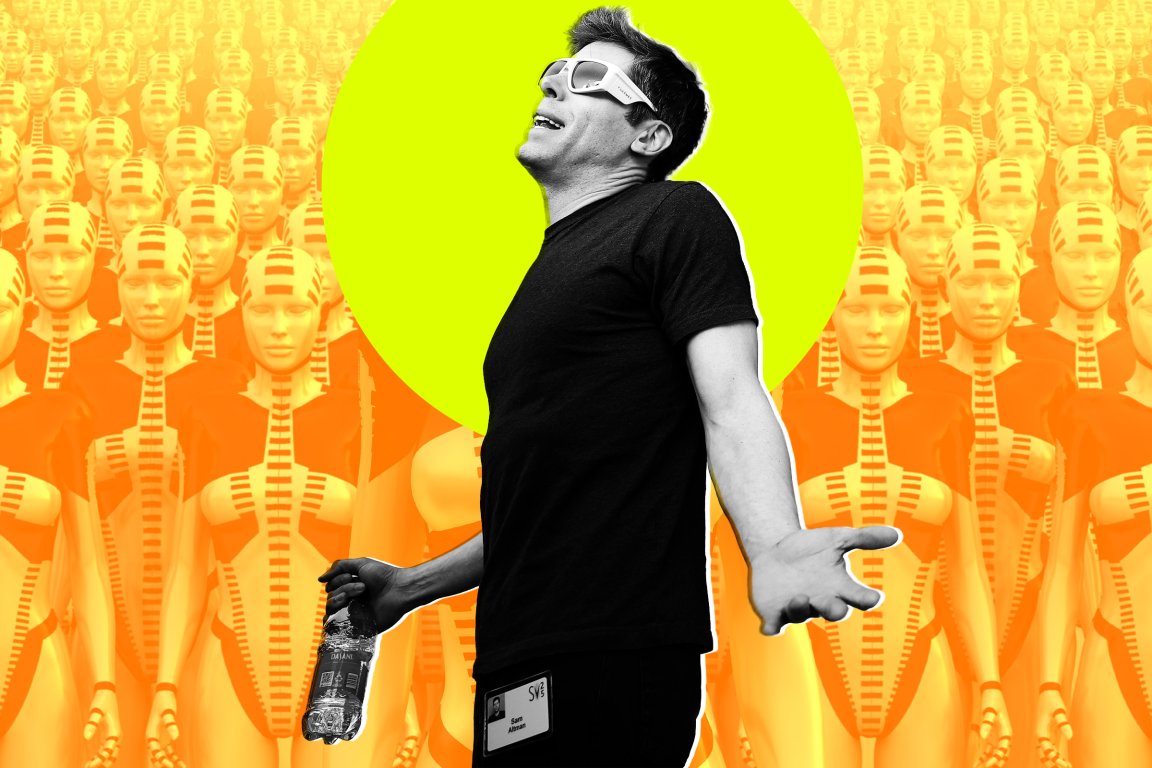
As artificial intelligence continues its rapid ascent, permeating industries from healthcare to finance, the tech titans steering this revolution have made no secret of their ambition: to automate vast swathes of human labor, thereby cementing their creations as indispensable to the global economy. Yet, as the prospect of widespread job displacement looms larger, a critical void remains in their narrative: a coherent, unified vision for a world where AI has fundamentally reshaped, or even eliminated, most traditional employment. What happens when the machines truly take over? The architects of this future, depicted in the illustration as powerful moguls overlooking the workforce, appear either genuinely stumped or strategically reticent on this pivotal question.
This stark reality was underscored recently by Geoffrey Hinton, often revered as a “godfather of AI” for his foundational work on neural networks. Speaking publicly, Hinton candidly observed, “It’s clear that a lot of jobs are going to disappear: it’s not clear that it’s going to create a lot of jobs to replace that.” His warnings carry significant weight, stemming from decades at the forefront of AI research before he famously left Google to speak more freely about the technology’s potential dangers. Hinton consistently highlights that the core issue isn’t AI itself, but rather our existing socio-economic frameworks. “This isn’t AI’s problem,” he continued, “This is our political system’s problem. If you get a massive increase in productivity, how does that wealth get shared around?” This question of equitable wealth distribution in an era of unprecedented productivity gains forms the crux of the debate, especially as AI investment becomes an increasingly central, if speculative, pillar of economies like that of the United States.
The visions offered by leading tech billionaires, while often grand, frequently lack concrete mechanisms for addressing the societal upheaval Hinton describes. Elon Musk, the entrepreneurial force behind SpaceX and Tesla, and currently one of the world’s wealthiest individuals, has frequently painted a picture of a future where AI and robotics usher in an era of universal abundance. He has recently championed the concept of “universal high income” – an evolution of universal basic income (UBI) – suggesting that every individual, liberated from the necessity of work, could live comfortably off the vast prosperity generated by private corporations, including his own beleaguered AI venture, xAI. Musk’s optimistic outlook posits a utopian society where humans are free to pursue creative endeavors and leisure, while AI handles all the mundane and complex tasks. However, critics, including The New Yorker’s John Cassidy, swiftly point out the fundamental flaw in such a proposition: such material abundance for displaced workers would necessitate a voluntary and unprecedented sharing of wealth and power by Musk and his billionaire peers. As Martin Luther King Jr. famously penned from Birmingham Jail, “it is an historical fact that privileged groups seldom give up their privileges voluntarily.” This historical precedent casts a long shadow of doubt over the feasibility of a future reliant on the voluntary largesse of the ultra-rich.
OpenAI’s CEO, Sam Altman, echoes a similar sentiment to Musk, proposing what he terms “universal extreme wealth.” His vision suggests that AI will drive down the cost of goods and services to near zero, making everything abundantly available, while simultaneously enabling individuals to hold ownership stakes in the AI companies generating this wealth. The mechanism for this widespread ownership, however, remains nebulous. How would billions of people acquire and maintain meaningful equity in complex, rapidly evolving tech enterprises? Without clear policy frameworks or regulatory interventions, such a scenario risks concentrating even more wealth and control in the hands of a select few, rather than democratizing it. The practical challenges of implementing such a system, from managing countless small shareholdings to educating a populace on market dynamics, are immense and largely unaddressed by Altman.
Mustafa Suleyman, co-founder of DeepMind and now CEO of Microsoft AI, offers a more direct, almost brutal, assessment of AI’s immediate impact. He unequivocally labels AI as a “fundamentally labor-replacing tool.” While acknowledging the mass economic turmoil this portends, Suleyman argues it is a worthwhile price for the long-term gains, asserting that “in 15 or 20 years’ time, we will be producing new scientific, cultural knowledge at almost zero marginal cost.” This perspective prioritizes abstract future benefits—unprecedented innovation and knowledge creation—over the immediate, tangible suffering of widespread unemployment and economic disruption. It raises profound ethical questions about who bears the cost of this transition and whether a few decades of societal upheaval are an acceptable trade-off for a potentially brighter, albeit undefined, future.
The economic projections available further dampen the utopian promises of these tech leaders. Goldman Sachs, for instance, predicts a modest 7 percent increase in global GDP over the next decade attributable to AI. The Penn Wharton Budget Model offers an even more conservative outlook, forecasting a 3.7 percent boost to GDP by 2075. While any bump in GDP is generally welcomed, these figures are far from the transformative economic shifts required to prevent widespread poverty and anguish in a scenario of mass job displacement, especially without significant wealth redistribution. To put it in perspective, the historical impact of the internet or previous industrial revolutions saw more substantial and rapid economic shifts, often accompanied by the creation of entirely new industries and job categories. The current AI projections suggest a more concentrated benefit, likely flowing disproportionately to capital owners rather than labor.
The disconnect between the soaring ambitions of AI development and the lack of robust, actionable plans for societal welfare is striking. The conversation consistently circles back to Hinton’s point: the problem is fundamentally political and economic, not purely technological. Relying on the goodwill or voluntary actions of the billionaire class, as history suggests, is a precarious strategy. If a future of “universal high income” or “universal extreme wealth” is genuinely desired, it will require proactive policy interventions – perhaps in the form of robust universal basic income schemes, significant retraining and re-skilling initiatives, re-imagined social safety nets, or even progressive wealth taxes – rather than vague assurances of future abundance. The tech industry, by driving this revolution, bears a moral responsibility to engage with these complex societal questions with the same rigor and innovation they apply to their algorithms. Otherwise, the promise of an AI-powered future risks becoming a dystopian reality for the majority, characterized by widespread joblessness, economic inequality, and social unrest. As Google CEO Sundar Pichai has also alluded to, society may simply have to “suffer through” the tumultuous transition, but without a clear roadmap, the suffering could be profound and protracted. The time for these moguls to put their money and their minds where their mouth is, offering concrete, equitable solutions, has never been more urgent.