Faris Adani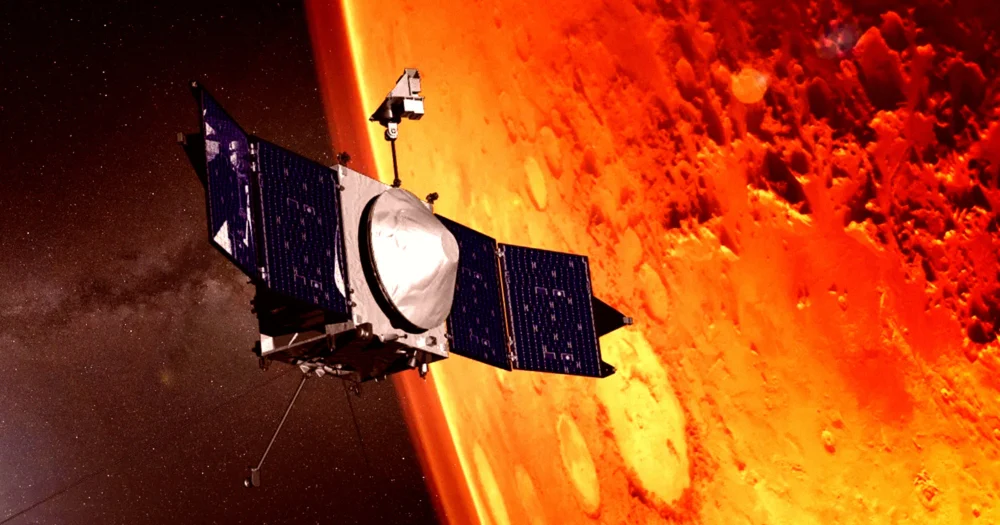
NASA Has Some Very Bad News About Its Mars Spacecraft. On December 6, 2025, a critical silence fell across the vast interplanetary expanse, as NASA’s MAVEN (Mars Atmosphere and Volatile EvolutioN) spacecraft, a stalwart sentinel orbiting the Red Planet for over a decade, mysteriously ceased communications and went offline, plunging mission control into an urgent crisis. This unexpected radio blackout marked the beginning of a desperate struggle by engineers and scientists to re-establish contact with an orbiter that has been instrumental in unraveling the secrets of Mars’ atmospheric history and its transition from a potentially habitable world to the arid desert it is today.
MAVEN, launched in November 2013 and entering Mars orbit in September 2014, was designed with a singular, profound objective: to understand how Mars lost much of its atmosphere and water, making it a crucial piece in the puzzle of planetary habitability. Its mission involved studying the planet’s upper atmosphere, ionosphere, and interactions with the solar wind. For over ten years, MAVEN has meticulously gathered data, observing the dynamic interplay between the Sun and the Martian atmosphere, particularly how solar storms can strip away atmospheric gases, contributing to the planet’s desiccation. Key discoveries from MAVEN have included mapping the distribution of Martian auroras, understanding the escape rates of atmospheric components like oxygen and hydrogen, and revealing the seasonal changes in the upper atmosphere. These insights are not just academic; they are vital for assessing the feasibility of future human missions to Mars, providing data on radiation environments and the long-term prospects for establishing sustainable outposts. The spacecraft’s longevity far exceeded its primary mission, making its sudden silence all the more poignant for the scientific community.
The initial alarm was raised when MAVEN failed to send telemetry data back to Earth, signals that were expected to be picked up by NASA’s Deep Space Network (DSN). Telemetry, essentially diagnostic data, provides engineers with crucial information about a spacecraft’s health, orientation, power status, and scientific instrument readings. Its absence meant that MAVEN was effectively blind to its controllers. The DSN, a sophisticated global system of massive radio antennas strategically placed in California, Spain, and Australia, forms the backbone of NASA’s interplanetary communications, enabling contact with dozens of spacecraft scattered across the solar system. The DSN’s failure to detect MAVEN’s signals underscored the severity of the problem; if even these highly sensitive instruments couldn’t hear it, the spacecraft was in deep trouble.
Less than a week after the initial loss of contact, on December 15, NASA issued its first update, revealing that MAVEN appeared to be “rotating in an unexpected manner when it emerged from behind Mars.” This detail was alarming, suggesting a loss of attitude control – the ability to maintain a stable orientation in space. Such a condition can lead to power generation issues if solar panels aren’t optimally pointed at the Sun, or communication problems if antennas are misaligned with Earth. The uncontrolled rotation further complicated efforts to re-establish contact, as the spacecraft might not be able to receive commands or transmit signals reliably. On December 23, the agency followed up with its last official update before the looming solar conjunction, promising that it was “continuing efforts to recontact” its lost spacecraft, a statement imbued with a sense of urgency and lingering hope.
However, weeks later, the situation deteriorated further, leading to a grim assessment. As SpaceNews senior writer Jeff Foust highlighted, Louise Prockter, the esteemed director of NASA’s planetary science division, conceded during a Tuesday meeting of the Small Bodies Assessment Group (SBAG) that the agency is now “very unlikely” to recover the MAVEN orbiter. Prockter’s statement carries significant weight; as a leader in NASA’s planetary science endeavors, her realistic appraisal reflects the diminishing chances based on ongoing analysis and the lack of positive developments. While not an outright declaration of mission loss, “very unlikely” conveys the profound challenges and the low probability of successful recovery, preparing the community for the potential end of a highly successful mission. The technical hurdles involved in re-establishing contact with a spacecraft that has lost attitude control, possibly suffered power system damage, and potentially experienced other cascading failures, are immense.
Despite the bleak outlook, a narrow window of opportunity is set to open. Mars’ solar conjunction, a weeks-long astronomical event where Mars and Earth are positioned on opposite sides of the Sun, is scheduled to end on January 16. During solar conjunction, the Sun’s coronal plasma interferes significantly with radio signals traveling between Earth and Mars, making reliable communication virtually impossible. The conclusion of this period will provide NASA with a new, clearer opportunity to reestablish contact, as the direct line of sight between the two planets will be restored, free from solar interference. In its December 23 update, the MAVEN team explained that they were diligently attempting to “create a timeline of possible events and identify the likely root cause of the issue” by meticulously analyzing “tracking data fragments recovered from a December 6 radio science campaign.” This forensic approach aims to piece together what transpired in the moments leading up to MAVEN’s silence, hoping to identify a specific anomaly that might inform recovery attempts. In a testament to the collaborative nature of Mars exploration, NASA also leveraged the Mastcam instrument attached to its Curiosity rover on the Martian surface to attempt to take a picture of MAVEN. This ambitious attempt, akin to trying to photograph a tiny speck of dust thousands of miles away, unfortunately failed to detect the missing spacecraft, further underscoring the difficulty of locating a small, silent object in the vastness of space.
The potential loss of MAVEN represents a sad state of affairs for NASA’s ongoing exploration of Mars, but fortunately, the Red Planet is not without its robotic guardians. Three other operational spacecraft – the Mars Reconnaissance Orbiter (MRO), Mars Odyssey, and the European Space Agency’s Trace Gas Orbiter (TGO) – continue to reliably relay communications between Mars surface missions (like the Curiosity and Perseverance rovers, and the InSight lander, though InSight is now defunct) and Earth. These orbiters provide critical communication infrastructure, ensuring that the valuable data collected by surface assets can still reach scientists on Earth. Furthermore, the future of Martian telecommunications may see a significant boost with the revived Mars Telecommunications Orbiter (MTO) project. This next-generation orbiter, specifically designed for high-bandwidth communication relay, was initially canceled but has seen a resurgence of interest and was mentioned in President Donald Trump’s so-called “Big, Beautiful Bill” act. While its development and eventual launch date remain unclear, a dedicated telecommunications orbiter would significantly enhance data transfer capabilities, crucial for the increasingly complex and data-intensive future missions, including the ambitious Mars Sample Return campaign.
The saga of MAVEN serves as a stark reminder of the inherent risks and formidable challenges involved in deep space exploration. Spacecraft, despite their robust engineering, operate in an unforgiving environment, vulnerable to radiation, extreme temperatures, micrometeoroid impacts, and the unpredictable nature of complex systems over long durations. Historically, Mars has been a challenging target, with numerous missions failing to reach orbit or successfully land, such as the Mars Climate Orbiter lost due to a unit conversion error, or the Beagle 2 lander that failed to deploy. However, these setbacks are often overshadowed by the remarkable successes, like the decades-long resilience of the Spirit and Opportunity rovers, the ongoing scientific triumphs of Curiosity and Perseverance, and the groundbreaking seismology performed by InSight. Each mission, whether successful or ultimately lost, contributes invaluable knowledge to humanity’s understanding of the cosmos and the engineering required to venture further.
For now, the MAVEN team clings to a sliver of hope that renewed efforts to make contact will prove successful once Mars emerges from behind the Sun. Every command sent, every signal listened for, represents a dedicated attempt to bring this vital scientific asset back online. Yet, given Louise Prockter’s candid and realistic comments, the situation isn’t looking promising. The scientific community is left to contemplate the potential loss of a mission that has profoundly shaped our understanding of Mars’ atmospheric evolution and its implications for life beyond Earth, while simultaneously preparing for a future where ingenuity and persistence will continue to push the boundaries of space exploration, even in the face of inevitable setbacks. The legacy of MAVEN, however, its decade of groundbreaking data and discoveries, will undoubtedly endure, continuing to inform and inspire future generations of Martian explorers.