Faris Adani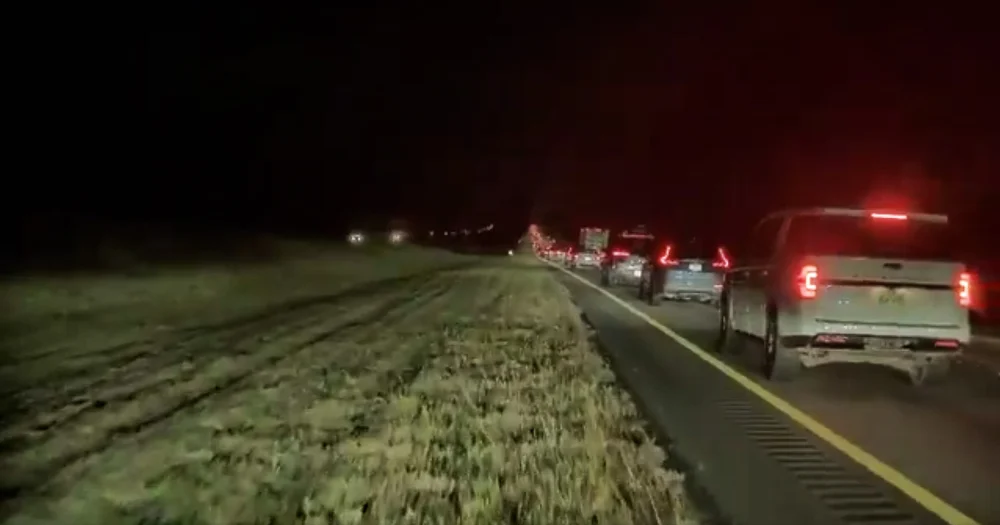
In a perplexing incident that has ignited fierce debate across social media and reignited scrutiny of autonomous driving technologies, a Tesla owner, known online as "The Electric Israeli" or "Dr. Moshe," lauded his vehicle’s Full Self-Driving (FSD) system for what many observers, backed by his own dashcam footage, viewed as a questionable, last-second maneuver that saw his car swerve dramatically off a busy highway and narrowly avoid a ditch, prompting questions about the actual capabilities of the software and the unwavering loyalty of its proponents. The contentious event unfolded on Interstate 95 in South Carolina during a night commute, where Moshe’s Tesla, operating under the highly touted but still beta FSD mode, was trailing an SUV. According to Moshe’s initial post, the car ahead "braked hard suddenly," leading FSD to "veer to the left and get back safely on the road," a sequence he described as life-saving and for which he expressed profound gratitude to "Tesla_AI." However, the accompanying video, widely circulated, painted a far more ambiguous picture of FSD’s supposed heroism. The footage clearly showed the Tesla maintaining what appeared to be a reasonable following distance, but when the lead SUV initiated braking and began to decelerate, the FSD system, and seemingly Moshe himself, failed to react promptly. Instead of a gradual, controlled reduction in speed or a smooth lane change, the Tesla’s self-driving software only engaged its brakes at the eleventh hour, executing an abrupt and seemingly uncalibrated swerve to the left, propelling the vehicle off the main highway and onto the depressed grass median, perilously close to plunging into a ditch. The dramatic intervention, far from appearing as a calculated, life-saving decision, struck many viewers as an overcorrection to a situation that, given the ample reaction time available, should have been managed with greater finesse and foresight. The continuous stream of bumper-to-bumper traffic visible in the distance further underscored the apparent lack of readiness from both the driver and the driving software, suggesting that an anticipation of stops and starts should have been paramount. Moshe’s subsequent tweet, stating, "We noticed at the same time," did little to clarify the situation, instead raising further questions about shared responsibility and the degree to which human oversight was actively engaged or merely reacting to FSD’s shortcomings. Critics were quick to point out that had the median not been a relatively level stretch of grass but rather contained obstacles, a steeper incline, or water, the outcome could have been catastrophic, rendering the "life-saving" praise not only premature but potentially dangerously misleading.
This incident is not an isolated one, but rather the latest in a series of highly publicized events where Tesla owners have exhibited what many describe as "blind devotion" or "cultish loyalty" to the brand and its often-controversial technology, even in the face of demonstrable failures or near-disasters. Last year, a Cybertruck owner similarly praised Tesla after his vehicle, reportedly running FSD, wrapped itself around a pole. Despite the significant damage and the clear implication of a system failure, the owner expressed gratitude for Tesla’s "engineering the best passive safety in the world," seemingly divorcing the structural integrity from the active driving system’s role in causing the crash. Another striking example involved a Model Y owner who, after FSD "obliterated a deer at full speed" without any discernible attempt to slow down or swerve, declared himself "insanely grateful" and enthused, "FSD works awesome!" This pattern suggests a deep-seated psychological phenomenon among a segment of Tesla’s user base, where the narrative of technological superiority and the promise of a revolutionary future often override empirical evidence of system flaws or operational hazards. This cognitive bias, potentially fueled by significant financial investment in the FSD package (which can cost thousands of dollars or a monthly subscription), a strong identification with Elon Musk’s vision, or a desire to be part of an exclusive technological vanguard, leads to a reinterpretation of adverse events as triumphs, or at least as acceptable learning experiences for an evolving AI. Such unwavering faith, however, carries tangible risks, fostering a sense of complacency and an over-reliance on a system that, by Tesla’s own admission and regulatory classification, is merely a Level 2 advanced driver-assistance system (ADAS), not an autonomous vehicle.
The fundamental misunderstanding of FSD’s capabilities remains a critical issue. Despite its evocative name, "Full Self-Driving" does not denote autonomy. It requires constant human supervision, with drivers explicitly warned to remain attentive and prepared to intervene at all times. This distinction is crucial, as the gap between marketing rhetoric and technical reality often leads to dangerous assumptions about the system’s robustness. Technically, FSD is an advanced cruise control system combined with lane-keeping assistance, automated lane changes, traffic light and stop sign recognition, and city street driving capabilities, all operating under the explicit requirement of human supervision. It struggles with numerous real-world scenarios, from navigating complex intersections and unprotected left turns to reacting predictably to sudden changes in traffic or environmental conditions like glaring sunlight, as noted in previous reports. The incident on I-95 highlights potential deficiencies in FSD’s perception and prediction algorithms, particularly its ability to accurately assess rapidly changing traffic dynamics and execute appropriate, safe evasive actions. Was it a sensor limitation in the dark? A software bug in interpreting the braking SUV? Or an overly aggressive, last-resort evasive strategy that kicked in when a more measured response was possible? Without detailed telemetry data, which Tesla rarely makes public, such questions remain speculative, fueling both fervent defense and trenchant criticism.
This ongoing disconnect between user perception, company marketing, and the actual technical limitations of FSD has not escaped the attention of federal regulators. The National Highway Traffic Safety Administration (NHTSA) has launched multiple investigations into Tesla’s FSD and Autopilot systems, citing frequent reports of "phantom braking" — where vehicles suddenly brake for no apparent reason — and, more disturbingly, incidents of Teslas "driving straight into the path of oncoming trains" at railroad crossings. These investigations have led to recalls and increased scrutiny over the safety practices surrounding these systems. The very notion that a driver might praise a system for veering off a highway, even if it "saved" them from a potential rear-end collision, underscores the perilous tightrope walk between innovation and safety. It forces a re-evaluation of how ADAS technologies are developed, tested, marketed, and perceived by the public. The cumulative effect of these incidents, coupled with the persistent narrative of user loyalty, creates a complex landscape where technological progress is celebrated, yet critical safety discussions are often overshadowed by brand allegiance. The promise of fully autonomous robotaxis, frequently championed by Elon Musk, appears increasingly like "smoke and mirrors" to many industry analysts and safety advocates, given the documented struggles of FSD with comparatively simpler highway and urban driving scenarios. If a system struggles to gracefully manage a common braking event on an open highway, the leap to operating a driverless taxi in complex, unpredictable urban environments seems monumental, if not presently insurmountable. Ultimately, this latest episode serves as a stark reminder that while advanced driver-assistance systems offer significant potential benefits, they are not infallible. They necessitate a vigilant human in the loop, a clear understanding of their limitations, and a critical perspective that prioritizes safety over unwavering belief in technology’s current state. The real "life-saving" element, for now, remains the attentive human driver, whose judgment and intervention are still paramount, especially when the software itself opts for a dramatic, potentially dangerous, off-road excursion.