Imroatul Nasiyah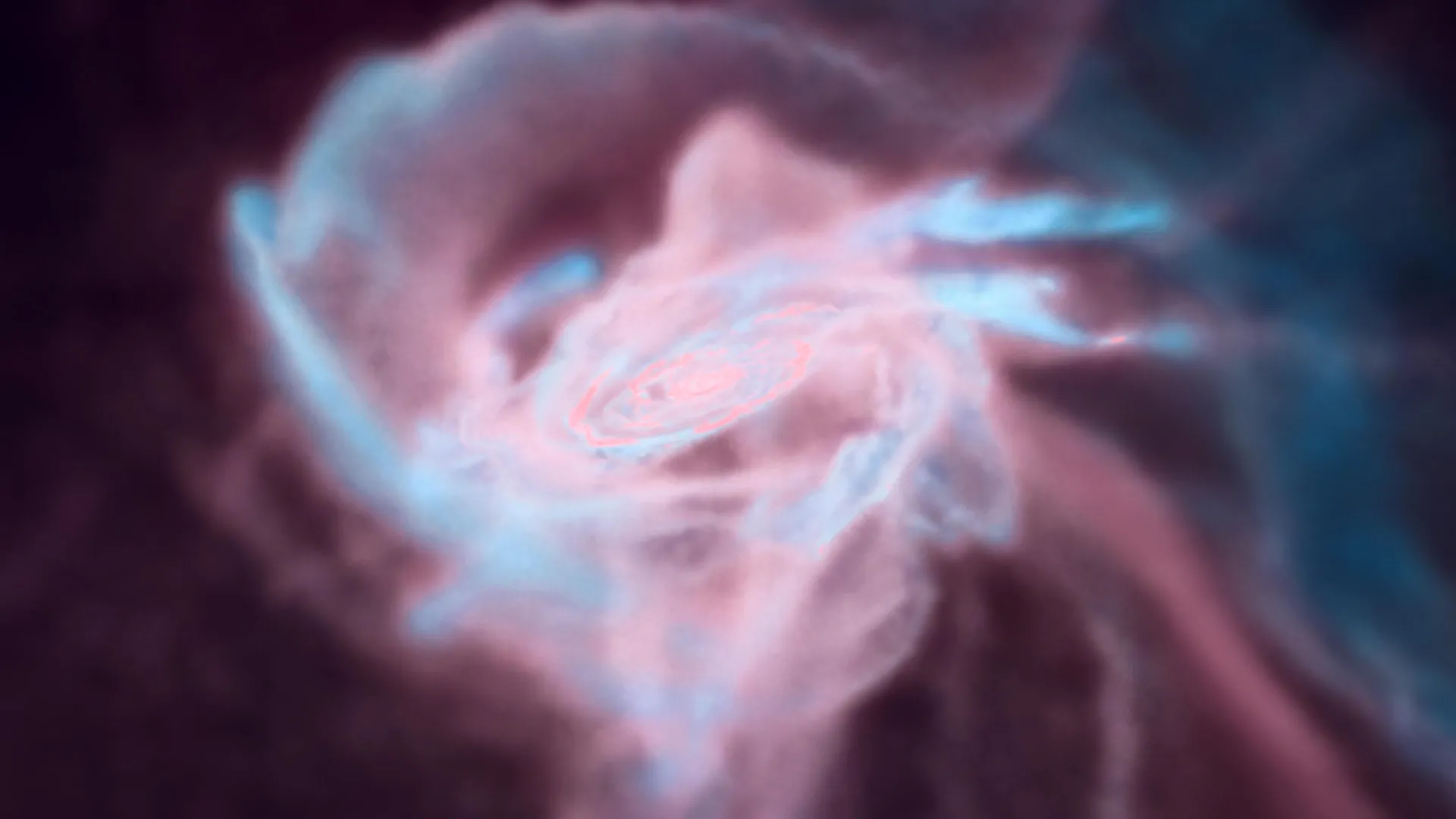
Among the myriad of cosmic revelations unveiled by the James Webb Space Telescope (JWST), a particularly perplexing discovery has captivated the astronomical community: a surprisingly abundant population of diminutive, intensely red celestial bodies, affectionately dubbed "Little Red Dots" (LRDs). For a considerable time, their enigmatic nature has defied definitive explanation. However, a groundbreaking new suite of simulations, meticulously executed on Japan’s formidable ATERUI III supercomputer, offers a compelling hypothesis: these peculiar objects might represent nascent black holes that experienced extraordinarily rapid growth, capitalizing on environmental conditions prevalent in the nascent Universe that have long since vanished.
The beauty of these findings lies in their elegant simplicity, eschewing the need for exotic physics or exceptionally improbable cosmic events. Instead, the sophisticated simulations point towards a natural genesis for the LRDs, rooted in the unique milieu of the early cosmos. In this primordial epoch, black holes were seemingly empowered to accrete matter at rates that dwarf anything observable in the present-day Universe, a veritable feeding frenzy on a cosmic scale.
Simulating the Crucible of the Early Universe
At the helm of this pivotal research is Sunmyon Chon of the Max Planck Institute for Astrophysics, whose team leveraged the immense computational prowess of the ATERUI III supercomputer, housed at the National Astronomical Observatory of Japan. Their objective was to conduct some of the most detailed and high-resolution cosmological simulations ever undertaken, specifically designed to reconstruct the conditions of the nascent Universe.
The simulation process was a marvel of computational astronomy, commencing with the broad strokes of a young galaxy and progressively zooming in on progressively smaller, more granular regions. This iterative refinement culminated in the detailed modeling of individual clouds of gas, a computationally intensive undertaking that demanded the unparalleled processing power of ATERUI III. The sheer scale of this endeavor underscores the complexity of accurately modeling the Universe’s formative years.
The results of these intricate simulations paint a vivid picture of the early Universe’s dynamic processes. They suggest that intense far-ultraviolet (FUV) radiation, emanating from the fiercely active, nearby galaxies that populated the young cosmos, played a crucial role in inhibiting the conventional formation of stars within certain gas clouds. Instead of fragmenting into a multitude of smaller stellar entities, as would be expected under less extreme conditions, these gas clouds were compelled by the overwhelming radiation pressure to collapse inwards, coalescing into a single, colossal supermassive star. This gargantuan stellar entity, a titan by any measure, then served as the precursor, its inevitable collapse forging the seed of a black hole.
Black Holes Unleashed: Growth at Unprecedented Velocities
Once these primordial black hole seeds were established, the simulations revealed a remarkable trajectory of rapid development. The dense gas environments surrounding these nascent black holes became particularly conducive to their voracious appetite. Thick disks of gas, rich in the very material they craved, formed around them. These gas-laden environments acted as cosmic insulation, trapping the emitted radiation and, crucially, enabling the black holes to consume surrounding matter with an efficiency that is simply unattainable in the comparatively quiescent conditions of the modern Universe.
Under these exceptionally favorable circumstances, the simulations demonstrate that these early black holes could achieve growth rates that were dozens of times faster than what is theoretically possible for black holes today. This accelerated accretion process allowed them to rapidly balloon in mass, a cosmic growth spurt of epic proportions. The striking resemblance between the simulated properties of these hyper-accreting black holes and the observed characteristics of the Little Red Dots detected by the JWST is a pivotal element of this hypothesis. This congruence strongly suggests that the mysterious red objects may indeed represent an early, fleeting phase in the lifecycle of black holes, characterized by their exceptionally rapid and efficient growth.
A Persistent Enigma in Black Hole Evolution
The existence of supermassive black holes in the early Universe has long been a source of consternation for astronomers. The observational evidence points to the presence of black holes with masses equivalent to millions, and even billions, of Suns, astonishingly existing less than 600 million years after the Big Bang. This temporal paradox has presented a significant challenge to existing models of black hole formation and growth, which typically predict a much slower evolutionary timeline.
The JWST was specifically designed and deployed with the expectation that its unparalleled sensitivity and observational range would shed light on this enduring mystery. By being able to detect fainter and more distant galaxies than any previous telescope, it promised an unprecedented glimpse into the Universe’s infancy. The fundamental principle of observing distant objects is, in essence, looking back in time. The light from a galaxy situated 11 billion light-years away has traversed the cosmos for 11 billion years before reaching our telescopes, thus presenting us with an image of that galaxy as it existed in the distant past. The same applies to galaxies even further away, their light carrying messages from the even earlier epochs of cosmic history. The JWST’s ability to pierce this cosmic veil, extending its gaze further back in time than ever before, has provided astronomers with an invaluable and unparalleled perspective on the formative stages of the Universe.
The Little Red Dots: A Potential Rosetta Stone for Early Black Hole Growth
Rather than immediately providing a definitive solution to the puzzle of early supermassive black hole formation, the JWST, in its initial observations, revealed something entirely unexpected: a widespread population of small, intensely red objects, which researchers promptly labeled as Little Red Dots (LRDs). These objects, with their peculiar spectral signature, presented a new layer of complexity to the ongoing investigation.
The newly proposed simulations offer a compelling interpretation of these enigmatic LRDs, suggesting they might indeed be the missing piece of the cosmic puzzle. According to this advanced theoretical model, the precise environmental conditions necessary for both the creation and the subsequent hyper-accelerated growth of these black holes naturally arose in the primordial Universe. This explanation is particularly powerful because it does not necessitate any speculative assumptions about exotic physics or improbable coincidences. This inherent naturalness could also elegantly explain the apparent ubiquity of the Little Red Dots observed by the JWST, suggesting they were a common phenomenon in the early cosmos.
As the JWST continues its tireless exploration of the distant Universe, undoubtedly uncovering more LRDs, and as future generations of telescopes push the boundaries of cosmic observation even deeper into the annals of time, this simulation-driven model could provide astronomers with a robust and valuable framework. This framework will be instrumental in deciphering the intricate processes by which some of the Universe’s very earliest black holes originated, achieved their prodigious growth, and ultimately played a pivotal role in shaping the grand evolutionary narrative of the cosmos as we know it. The LRDs, once a baffling anomaly, may now stand as a testament to the dynamic and surprisingly rapid processes that governed the Universe in its infancy.