Imroatul Nasiyah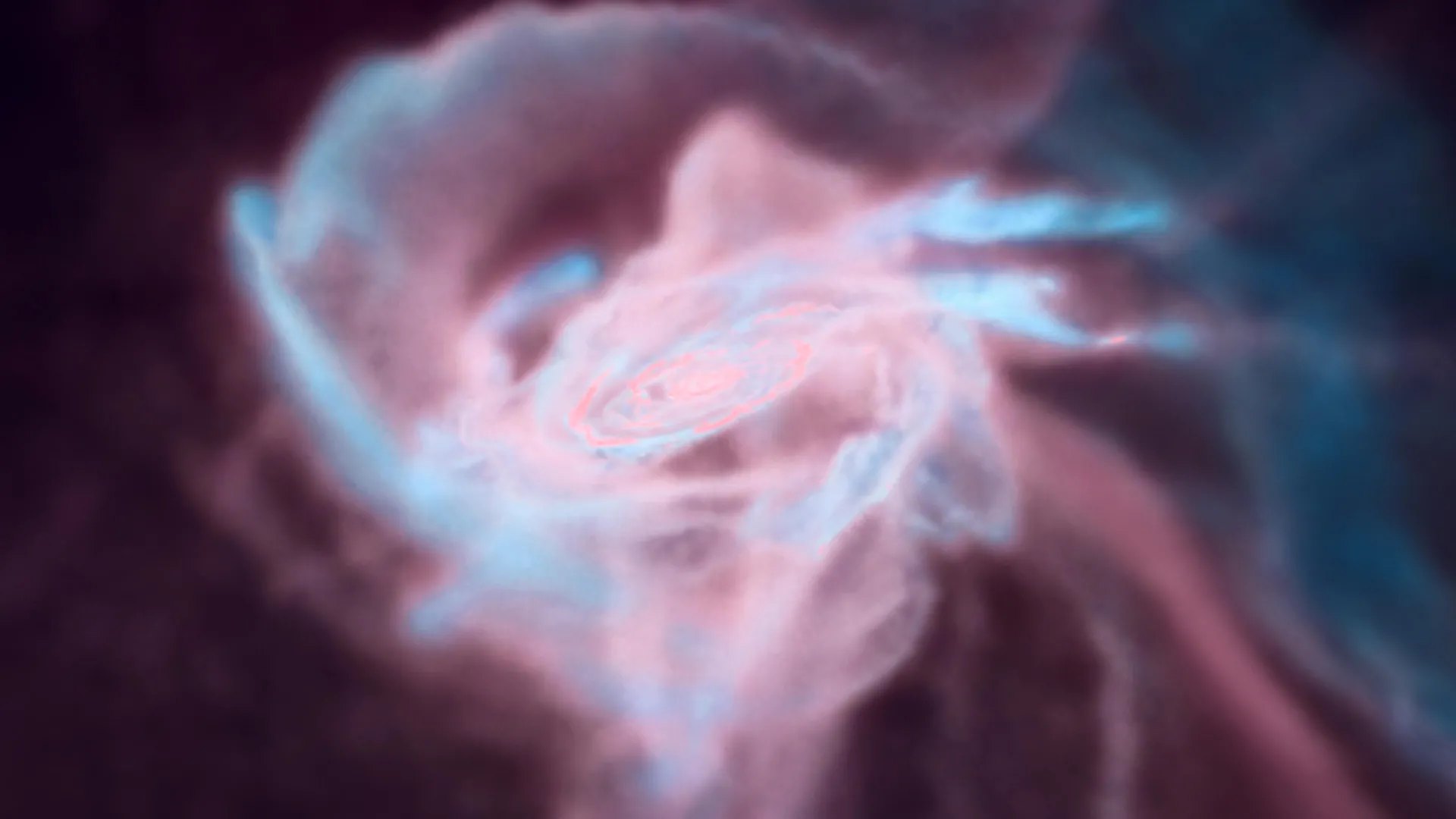
These revolutionary findings eschew the need for speculative or exotic physics, nor do they rely on improbable cosmic coincidences. Instead, the sophisticated simulations indicate that the formation and rapid accretion of these LRDs could have occurred quite naturally within the dynamic milieu of the young cosmos, a period where black holes were empowered to grow at rates hitherto unimaginable in the present-day Universe. This paradigm-shifting research, spearheaded by Sunmyon Chon of the esteemed Max Planck Institute for Astrophysics, represents a significant leap forward in our comprehension of the Universe’s formative epochs. The team harnessed the immense processing capabilities of the ATERUI III supercomputer, located at the National Astronomical Observatory of Japan, to conduct some of the most detailed and high-fidelity cosmological simulations of the early Universe ever attempted.
The intricate simulation process commenced by modeling the vast scales of a nascent galaxy, then progressively zoomed in on progressively smaller regions, eventually resolving down to the level of individual, vast clouds of primordial gas. This exceptionally demanding computational approach necessitated the unparalleled high-resolution processing power that ATERUI III so effectively provides. The outcomes of these simulations are profoundly revealing. They suggest that the intense far-ultraviolet (FUV) radiation, a potent form of electromagnetic energy emanating from nearby, young galaxies, could have exerted a significant influence on the gas clouds within certain regions. This pervasive radiation field, it appears, could have actively suppressed the formation of ordinary, fragmented stars within these gas clouds. Instead of undergoing the typical fragmentation process, which would lead to the birth of numerous smaller stellar bodies, the gas within these clouds was apparently compelled to collapse gravitationally under its own immense mass, ultimately forming a single, colossal supermassive star.
This gargantuan, primordial star, born from the collapse of a massive gas cloud, then served as the crucible for the genesis of a black hole seed. Once these initial black hole seeds were formed, the detailed simulations illustrate a subsequent critical phase: they became enveloped by thick, swirling disks of incredibly dense gas. These gas-rich environments were not merely passive surroundings; they actively trapped radiation, creating a hyper-efficient feeding ground for the nascent black holes. This efficient accretion process allowed the black holes to consume surrounding matter at rates dramatically exceeding anything observed in the modern Universe. Under these exceptionally favorable conditions, the simulated black holes were able to grow exponentially, achieving masses dozens of times greater than what would be achievable with current astrophysical processes.
Crucially, the observed properties of these simulated, rapidly growing black holes bear a striking resemblance to the Little Red Dots (LRDs) that have been detected by the JWST. This remarkable concordance strongly suggests that these enigmatic red objects, observed by Webb, may indeed represent an early, nascent stage of extremely rapid black hole growth, a critical phase in the Universe’s evolution.
The formation and early evolution of supermassive black holes have long presented a formidable puzzle to astrophysicists. For decades, astronomers have grappled with the perplexing observation that supermassive black holes, possessing masses millions or even billions of times that of our Sun, already existed astonishingly early in cosmic history, some appearing less than 600 million years after the Big Bang. The prevailing cosmological models struggled to account for such rapid growth, which would require black holes to accumulate vast amounts of matter in an exceedingly short period.
The deployment of the JWST was anticipated to be a pivotal instrument in unraveling this long-standing mystery. Its unparalleled sensitivity and observational capabilities were expected to allow astronomers to detect fainter and more distant galaxies than ever before, effectively pushing the observational frontier further back into the cosmic past. The fundamental principle at play is the finite speed of light: observing extremely distant objects is tantamount to looking back in time. For instance, if a galaxy is observed at a distance of 11 billion light-years, the light we detect has journeyed for 11 billion years to reach Earth. Consequently, we are witnessing that galaxy as it appeared 11 billion years in the past. The same principle applies to an even more distant galaxy, 12 billion light-years away, whose light has been traveling for 12 billion years. The JWST’s extraordinary capacity to peer farther back in time than any previous observatory has provided astronomers with an unprecedented and invaluable view of the Universe in its infancy.
However, rather than immediately providing a definitive solution to the early black hole growth enigma, the JWST unveiled a new layer of complexity: the discovery of a substantial population of these tiny, intensely red objects, the Little Red Dots (LRDs). The new simulations, by proposing that these LRDs are indeed rapidly growing black holes, suggest that they might actually be the missing observational evidence, the crucial piece of the puzzle that astronomers have been searching for.
According to the proposed model, the necessary conditions for both the creation of these black hole seeds and their subsequent rapid growth naturally arose within the unique environment of the early Universe. This model does not necessitate any exotic physics or highly improbable coincidences, which is a significant advantage for its credibility. This inherent naturalness also offers a compelling explanation for why Little Red Dots appear to be so prevalent in JWST observations. Their abundance suggests they were a common feature of the early cosmic landscape.
As the JWST continues its groundbreaking observations, diligently identifying more LRDs, and as future telescopes are developed to probe even deeper into the annals of cosmic history, this simulation-driven model is poised to provide astronomers with an invaluable conceptual framework. This framework will be instrumental in understanding the intricate processes by which some of the Universe’s earliest and most massive black holes formed, underwent their astonishingly rapid growth, and ultimately played a pivotal role in shaping the subsequent evolution of the cosmos. The LRDs, once a perplexing anomaly, may now hold the key to unlocking fundamental questions about the birth and growth of the most massive structures in the Universe.