Imroatul Nasiyah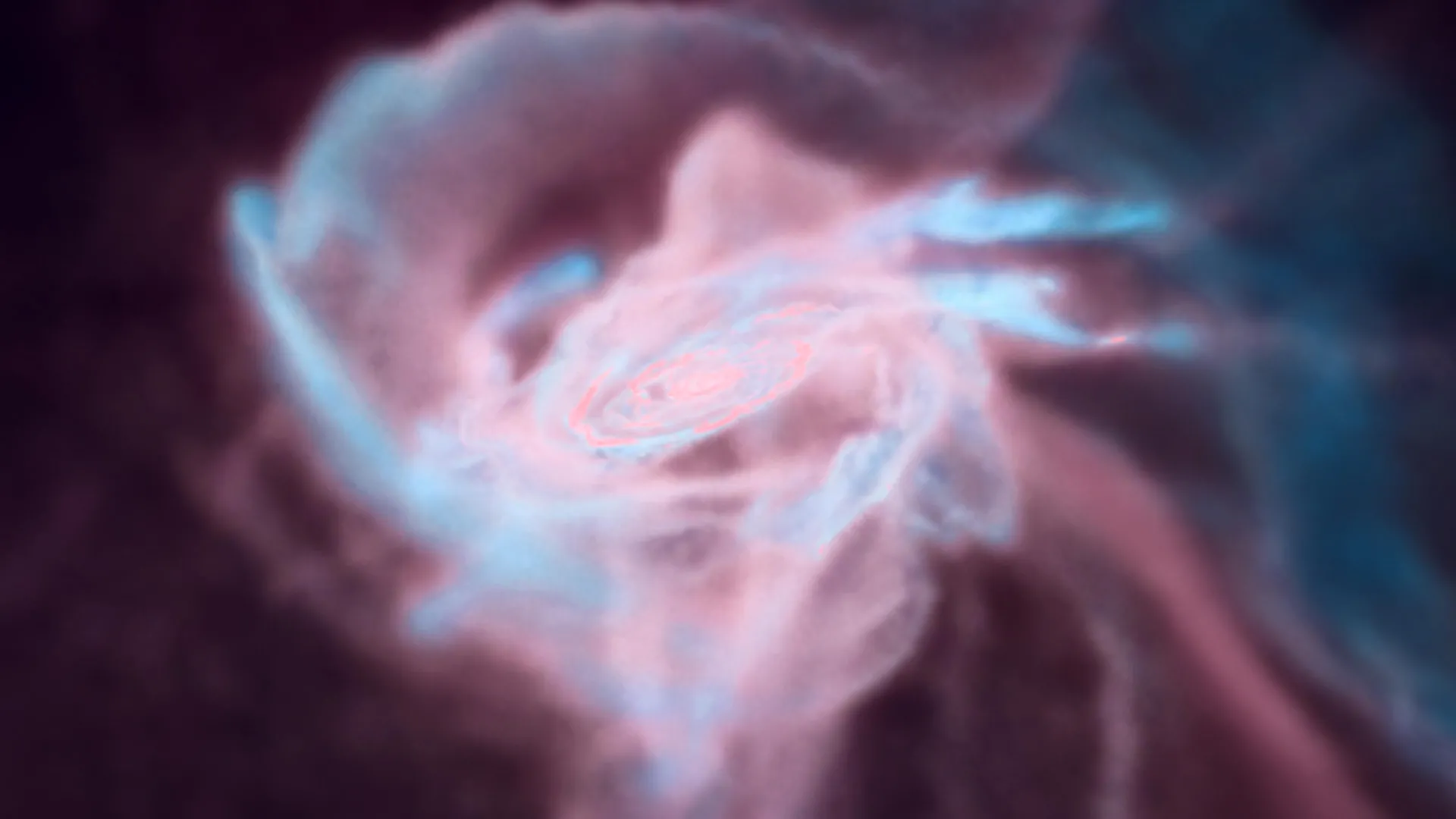
Among the myriad astonishing revelations emerging from the James Webb Space Telescope (JWST), one of the most enigmatic has been the detection of a substantial population of diminutive, intensely red celestial bodies, colloquially dubbed "Little Red Dots" (LRDs). For a considerable period, their fundamental nature remained shrouded in profound uncertainty, posing a significant puzzle for astrophysicists. However, a groundbreaking series of sophisticated simulations, meticulously executed utilizing the formidable computational prowess of Japan’s ATERUI III supercomputer, now propose a compelling hypothesis: these peculiar objects may indeed represent black holes in the throes of exceptionally rapid accretion, having capitalized on the unique environmental conditions prevalent in the nascent Universe—conditions that are no longer replicated in our present cosmic epoch.
These revelatory findings, rather than invoking the necessity of exotic, hitherto undiscovered physics or exceptionally improbable cosmic occurrences, instead suggest a far more elegant and grounded explanation. The advanced simulations indicate that the phenomenon of the Little Red Dots could arise as a natural consequence of the early Universe’s distinctive milieu, a period characterized by an environment uniquely conducive to black holes achieving extraordinary rates of growth. This paradigm shift in understanding has the potential to fundamentally alter our perception of how the first supermassive black holes came to dominate the cosmic landscape so early in its history.
Simulating the Genesis of the Early Universe and its Black Hole Seeds
The pioneering research that underpins this transformative hypothesis was spearheaded by Sunmyon Chon, a distinguished astrophysicist affiliated with the esteemed Max Planck Institute for Astrophysics. Collaborating with a dedicated team, Chon leveraged the immense computational capabilities of the ATERUI III supercomputer, housed at the National Astronomical Observatory of Japan. This state-of-the-art facility enabled the execution of what are considered among the most detailed and high-fidelity cosmological simulations ever undertaken, specifically designed to probe the conditions of the primordial Universe.
The intricate simulation process commenced by modeling the conditions on the scale of a nascent galaxy, gradually refining the focus to encompass progressively smaller regions of space. This meticulous process culminated in the resolution of individual clouds of gas, a demanding computational feat that necessitated the unparalleled high-resolution processing power offered by the ATERUI III supercomputer. The rationale behind this granular approach was to accurately capture the complex interplay of forces and matter distribution that governed the early cosmos.
The outcomes of these simulations yielded a profound insight: intense far-ultraviolet (FUV) radiation, emanating from nearby nascent galaxies, played a crucial role in actively suppressing the formation of conventional stars within certain gas clouds. Instead of fragmenting into a multitude of smaller stellar entities, as would typically occur, the gas within these irradiated clouds underwent a remarkable process of direct collapse. This gravitational implosion led to the formation of a single, colossal supermassive star, an object of unimaginable scale and density.
Following its brief but spectacular existence, this gargantuan star would then inevitably succumb to its own immense gravitational forces, triggering a catastrophic collapse. This ultimate collapse would pave the way for the creation of a "black hole seed"—a nascent black hole, albeit one born from stellar death rather than the more commonly theorized direct collapse of vast gas clouds. This stellar-derived origin adds another fascinating layer to the complex tapestry of black hole formation in the early Universe.
Black Holes Engulfing Matter at Unprecedented Velocities
Once these black hole seeds, born from the fiery demise of supermassive stars, were established, the simulations unveiled a subsequent stage of astonishing activity. The research indicates that these nascent black holes rapidly became enveloped by thick, swirling disks of exceptionally dense gas. These gas-rich environments were not merely passive surroundings; they acted as potent gravitational traps, effectively containing and channeling vast quantities of infalling material towards the central black hole.
Crucially, these dense gas disks played a pivotal role in the black holes’ accelerated growth. The trapped radiation, a byproduct of the accreting gas, further amplified the gravitational pull and efficiency of matter consumption. This symbiotic relationship between the black hole and its dense gaseous shroud allowed these cosmic behemoths to "feed" at rates far exceeding anything observed in the modern Universe. Under these primordial conditions, the simulations demonstrate that these black holes could achieve growth rates that were dozens of times faster than what is theoretically possible today. This accelerated accretion is the key to understanding how such massive black holes could exist so early.
The intrinsic properties of these simulated black holes, including their luminosity, spectral characteristics, and inferred masses, exhibited a striking resemblance to the Little Red Dots (LRDs) that have been meticulously observed by the James Webb Space Telescope. This remarkable congruence strongly suggests that the mysterious red objects detected by JWST might indeed represent a crucial, albeit transient, early phase in the lifecycle of black holes undergoing extraordinarily rapid growth. They are not merely passive observers of cosmic evolution but active participants in its very genesis.
Addressing a Long-Standing Enigma in Black Hole Cosmology
For decades, astronomers have grappled with a profound and persistent mystery: how did supermassive black holes, with masses millions or even billions of times that of our Sun, manage to assemble themselves so remarkably early in the Universe’s history? The cosmic timeline indicates that some of these colossal entities already existed less than 600 million years after the Big Bang, a period that astrophysicists considered too brief for such gargantuan structures to form through conventional accretion processes. This temporal paradox has been a significant thorn in the side of cosmological models.
The deployment of the James Webb Space Telescope was anticipated to provide crucial insights into this puzzle. With its unparalleled sensitivity and ability to observe fainter and more distant galaxies than any preceding observatory, JWST was expected to offer an unprecedented window into the early Universe, allowing astronomers to detect and study these elusive early black holes. The fundamental principle at play is the finite speed of light. By observing extremely distant objects, astronomers are effectively looking back in time. A galaxy situated 11 billion light-years away, for instance, reveals itself as it was 11 billion years ago, its light having traversed the vast cosmic expanse over that immense duration. Similarly, a galaxy 12 billion light-years away presents an even older snapshot of the Universe. JWST’s extended reach into the cosmic past offers an unparalleled vantage point for unraveling these ancient mysteries.
The Little Red Dots: A Potential Key to Unlocking the Cosmic Black Hole Puzzle
Instead of immediately resolving the long-standing enigma of early supermassive black hole formation, JWST, in its characteristic fashion of exceeding expectations, unveiled a new and unexpected phenomenon: a significant population of small, intensely red objects that researchers began to categorize as Little Red Dots (LRDs). These objects defied easy explanation within existing theoretical frameworks, adding another layer of complexity to the cosmic puzzle.
The recent simulations, however, propose that these very LRDs may indeed hold the missing piece of the intricate black hole formation puzzle. According to the sophisticated model developed by Chon and his team, the specific environmental conditions required to both create these initial black hole seeds and fuel their subsequent hyper-accretion were not anomalies. Instead, they appear to have arisen naturally from the dynamic and energetic processes inherent in the early Universe. This implies that no extraordinary, ad hoc assumptions or exceedingly rare cosmic coincidences are necessary to explain their existence. This naturalistic explanation could also shed light on why Little Red Dots appear to be so prevalent in JWST observations; they are a natural, albeit fleeting, consequence of the early cosmic environment.
As the James Webb Space Telescope continues its groundbreaking observations, discovering more LRDs and pushing the boundaries of our cosmic vision even further, and as future telescopes venture even deeper into the annals of cosmic history, this newly proposed model offers a valuable and robust framework. It promises to provide astronomers with a more comprehensive understanding of how some of the Universe’s earliest and most massive black holes came into being, achieved their prodigious growth, and, in doing so, played a pivotal role in shaping the subsequent evolution of the cosmos into the grand and complex structure we observe today. The Little Red Dots, once a mystery, may well be the cosmic Rosetta Stone for understanding the birth of giants.