anjir abdul
The core of the contention lies in the fundamental disagreement over how these platforms should be classified and, consequently, regulated. Companies such as Kalshi contend that their offerings constitute legitimate financial instruments, specifically "swaps," falling under the purview of the Commodity Futures Trading Commission (CFTC) as regulated by the Commodity Exchange Act (CEA) and the Dodd-Frank Wall Street Reform and Consumer Protection Act of 2010. New Jersey, however, vehemently argues that these contracts are, in essence, illegal sports betting, subject to stringent state gambling laws designed to protect consumers and maintain integrity within the gambling industry.
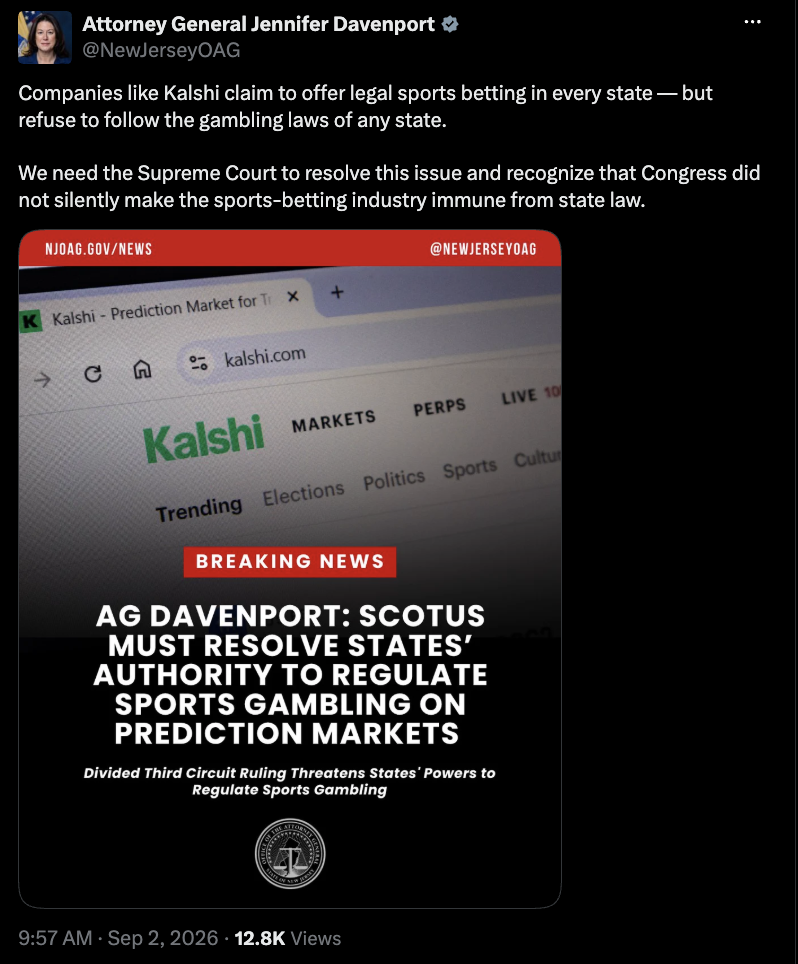
Attorney General Davenport articulated the state’s frustration and determination, stating, "Companies like Kalshi claim to offer legal sports betting in all 50 States, but they refuse to follow the gambling laws of any State. These companies have no right to offer their sports bets without following state law, which is why dozens of States across the ideological spectrum have opposed them." Her remarks underscore the widespread state-level opposition to what is perceived as a circumvention of established regulatory frameworks. Davenport further emphasized the imperative for judicial clarity, asserting, "We’re calling on the Supreme Court to resolve this issue and recognize that Congress did not silently make the sports-betting industry immune from state law." This statement highlights the principle of federalism, where states traditionally hold significant authority over matters like gambling, and challenges the notion of implicit federal preemption.
The legal journey leading to this Supreme Court petition has been complex. New Jersey’s enforcement actions against Kalshi were initially aimed at halting what it considered unlicensed gambling operations within its borders. However, an April opinion from the US Court of Appeals for the Third Circuit dealt a setback to the Garden State’s efforts. In a 2-1 ruling, the appellate judges sided with Kalshi, determining that the company had a "reasonable chance of success" in arguing that the CFTC’s Commodity Exchange Act (CEA) preempted state law. This ruling effectively suggested that federal oversight might indeed supersede state regulations in this specific context, providing a significant victory for prediction market operators.
The petition specifically challenges the CFTC’s expansive claim that sports bets offered on prediction market platforms qualify as "swaps" under the agency’s regulatory scope. New Jersey’s filing explicitly states that "federal law does not preempt state sports-gambling laws regardless," directly disputing the Third Circuit’s interpretation and the very foundation of Kalshi’s defense. The question presented to the Supreme Court is precisely "whether the 2010 Dodd-Frank Wall Street Reform and Consumer Protection Act preempted States from regulating sports bets that occur within their jurisdictions if those bets are offered on markets registered with the [CFTC]." This question cuts to the heart of the regulatory ambiguity surrounding prediction markets and the balance of power between federal and state authorities. Cointelegraph reached out to the CFTC for comment but did not receive an immediate response, indicating the sensitive and ongoing nature of the legal deliberations.

Understanding the nature of prediction markets is crucial to grasp the stakes of this legal battle. Unlike traditional sports betting, which typically involves betting against a sportsbook’s odds, prediction markets allow users to buy and sell "event contracts" based on the future outcome of events, including sports, politics, and economic indicators. These contracts typically settle at $1 if the predicted event occurs and $0 if it does not, with their prices fluctuating based on market demand, reflecting the crowd’s perceived probability of an outcome. Kalshi, for instance, operates under the premise that these contracts are financial derivatives—specifically "event contracts" deemed "swaps" by the CFTC—and thus fall under federal financial regulation, not state gambling laws.
The potential consequences of a Supreme Court decision in this area are far-reaching, not just for Kalshi but for the entire prediction market industry, state regulators, and the broader landscape of sports betting. The New Jersey AG’s announcement on the petition highlighted a critical, almost paradoxical, outcome if Kalshi were to prevail: "Because federal law prohibits trading swaps off CFTC-registered markets, a victory for Kalshi would mean that all sports gambling off such CFTC-registered markets would seemingly become illegal even if state law allows it." This scenario implies that if prediction markets are indeed exclusively federal "swaps," then traditional sports betting, which is not regulated by the CFTC, could be seen as operating outside the legally sanctioned framework for such instruments, potentially creating a complex legal quagmire.
Kalshi, for its part, expressed disagreement with New Jersey’s decision to appeal to the Supreme Court. Dani Lever, a spokesperson for Kalshi, reiterated the company’s position to Cointelegraph, arguing that prediction markets "could not be regulated by 50 different regulators." This statement underscores the industry’s desire for a unified, federal regulatory framework rather than a fragmented, state-by-state patchwork of rules, which they argue would stifle innovation and make nationwide operations untenable. Lever added, "We remain confident in the lower courts’ rulings, and nothing in New Jersey’s filing today changes our view," indicating their firm belief in the merits of their legal position.
The Supreme Court’s decision on whether to grant a writ of certiorari is a critical first hurdle. The Court receives thousands of petitions annually but typically hears fewer than 100 cases. Factors influencing their decision often include the existence of a "circuit split" (where different federal appellate courts have issued conflicting rulings on the same legal question), the national importance of the issue, and cases involving significant federalism questions—all of which are present in this dispute. Experts have been speculating about the possibility of the justices weighing in on prediction markets, with some discussions centering on a similar case that went to an appellate court in Nevada. Whether the Supreme Court chooses to hear the Kalshi case originating from New Jersey, the one in Nevada, or an enforcement action against a different prediction market company down the line, any potential decision would set a monumental precedent for which authorities can regulate prediction markets, fundamentally reshaping their future in the United States.
A ruling affirming federal preemption could solidify the CFTC’s role as the primary regulator for these platforms, potentially allowing them to operate across state lines with a single federal license, much like other financial markets. This could lead to a boom in prediction market activity, offering new avenues for individuals to speculate on various outcomes. However, it would also strip states of their traditional authority over gambling, raising concerns about consumer protection, responsible gaming, and potential revenue losses from state-licensed sports betting.
Conversely, a ruling in favor of New Jersey and state-level regulation would mean that prediction market companies would likely need to comply with each state’s specific gambling laws, potentially requiring licenses and adhering to diverse operational requirements. This could severely restrict their ability to operate nationally, potentially leading to a more fragmented market or outright bans in states where such contracts are deemed illegal gambling. It would reinforce the long-standing principle of states’ rights in regulating activities within their borders, particularly those historically classified as gambling.
The ongoing debate also touches on broader philosophical questions about the nature of speculation and risk. Are prediction markets genuinely financial instruments that provide valuable price discovery and hedging opportunities, or are they sophisticated forms of gambling that exploit human tendencies toward speculation? The answer to this question, ultimately, will be heavily influenced by how the Supreme Court interprets the existing federal statutes and their interaction with state laws.
The stakes are undoubtedly high. For states like New Jersey, it’s about preserving their regulatory sovereignty and protecting their citizens from what they perceive as unregulated gambling. For companies like Kalshi, it’s about securing a clear, unified regulatory path that allows them to innovate and operate efficiently across the nation. For the Supreme Court, it’s an opportunity to provide much-needed clarity on a rapidly evolving area of law at the intersection of finance, technology, and traditional regulatory frameworks. The outcome will not only define the future of prediction markets but also send a powerful signal about the enduring balance of power within America’s federalist system.