anjir abdul
Decentralized exchange Hyperliquid and memecoin launchpad Pump.fun have emerged as dominant forces in the burgeoning trend of token buybacks within the cryptocurrency ecosystem, collectively accounting for an astonishing nearly 90% of the record $638 million in token repurchases executed by crypto projects year-to-date in 2026, a strategic financial maneuver that underscores a significant maturation in the industry’s approach to value creation and investor returns. This unprecedented surge in capital allocation towards supporting native token valuations mirrors established practices in traditional financial markets and signals a renewed focus on delivering tangible, revenue-backed value to token holders amidst evolving and often volatile market conditions.
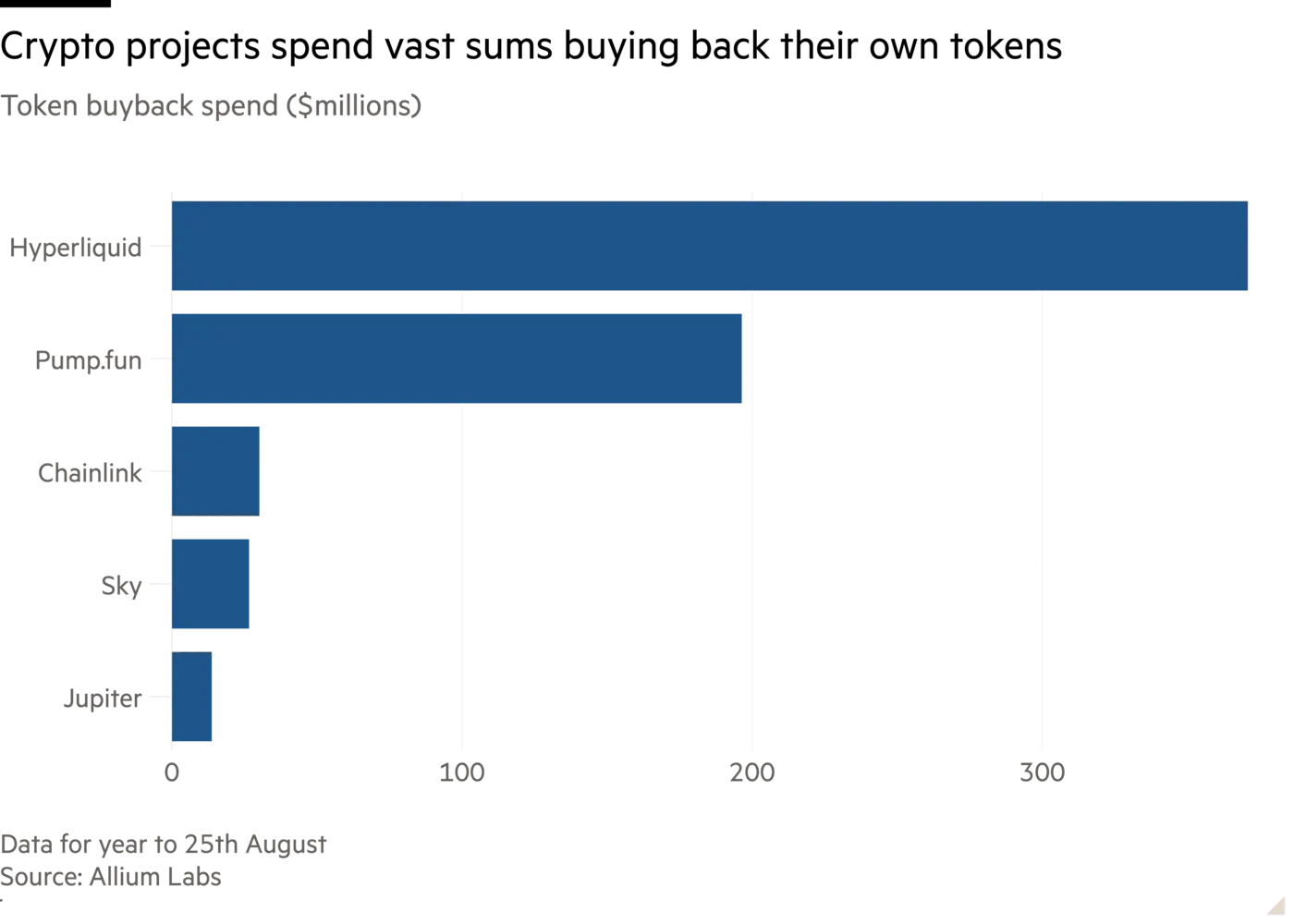
The staggering $638 million spent on token buybacks represents a monumental increase from previous years, highlighting a rapidly accelerating and increasingly adopted trend across the decentralized finance (DeFi) landscape. According to comprehensive data compiled by Allium Labs and prominently cited by the Financial Times in a recent Monday report, this figure is not only a new record but also substantially higher than the $545 million recorded during the same period in 2025 and dwarfs the mere $366,000 observed in 2024. This exponential growth over a short span illustrates a clear and decisive shift in how decentralized protocols and crypto companies manage their treasuries and engage with their tokenomics, moving towards more shareholder-friendly policies. Of this record sum, Hyperliquid, a high-performance decentralized perpetuals exchange known for its innovative Layer 1 architecture, was singularly responsible for approximately $370 million in buybacks, cementing its position as a leader in this financial strategy. Concurrently, Pump.fun, the innovative platform that has democratized memecoin creation and distribution, contributed nearly $200 million. Their combined activity, totaling roughly $570 million, unequivocally places them at the forefront of this financial phenomenon, demonstrating both their robust revenue generation capabilities and their explicit commitment to value accrual for their respective tokens.
Token buybacks in the cryptocurrency world are fundamentally analogous to share buybacks conducted by publicly listed companies in traditional finance. In the corporate sphere, companies repurchase their own stock from the open market primarily to reduce the number of outstanding shares. This action typically results in an increase in earnings per share (EPS), often boosts the stock’s price, and can improve other financial ratios, making the company more attractive to investors. It’s a method of returning capital to shareholders, signaling management’s confidence in the company’s future prospects, and potentially preventing dilution. In the crypto sphere, the objectives are largely similar: to support the token’s price, reduce its circulating supply, and ultimately increase returns for existing token holders by making their remaining holdings proportionally more valuable and scarce. The specific mechanisms can vary; tokens can be "burned" (permanently removed from circulation), distributed as staking rewards, or allocated to a protocol’s treasury for future strategic use, such as providing liquidity or funding ecosystem grants. Regardless of the exact method, the underlying principle remains consistent: to create scarcity, enhance value capture, and align the economic incentives of the protocol with its token holders.

While token buybacks have historically been a less common practice in the nascent crypto industry, their adoption is rapidly gaining traction as projects mature, generate sustainable revenue, and seek to establish robust, long-term economic models. The Ethena Foundation, for instance, recently initiated a significant governance proposal that exemplifies this growing industry-wide trend. On a recent Thursday, the foundation opened a community vote on a fee-switch proposal, outlining a comprehensive plan to utilize a substantial 95% of the net revenue generated from Ethena’s core business lines to repurchase Ethena (ENA) tokens from the open market. This proactive move, explicitly designed to channel protocol revenue directly back into strengthening its native asset, was met with immediate and overwhelmingly positive market reaction; the ENA token saw a notable price increase of 10.7% on the day the proposal was announced. Such initiatives underscore a broader industry recognition that direct, transparent, and consistent value accrual mechanisms are increasingly crucial for long-term token health, fostering investor confidence, and differentiating projects in a competitive market. The inherent transparency of these on-chain operations, often auditable and executed via smart contracts, adds a layer of trust and accountability that further distinguishes them from traditional corporate buybacks, which can sometimes be perceived as opaque.
The strategic and aggressive implementation of token buybacks by both Hyperliquid and Pump.fun has demonstrably paid off, with their respective native tokens, HYPE and PUMP, significantly outperforming the broader cryptocurrency market in 2026. This stark contrast in performance is particularly noteworthy given the general market downturn observed during the same period. According to real-time data from TradingView, the HYPE token surged by an impressive 145% year-to-date, showcasing exceptional resilience and growth. Similarly, the PUMP token climbed by a robust 109%, reflecting strong investor confidence. In stark contrast, the flagship cryptocurrency Bitcoin (BTC) experienced a 10% decline in its price, and the total crypto market capitalization contracted by 11.9% over the identical timeframe, indicating a challenging macro environment for digital assets. This significant decoupling of performance suggests that projects with strong, verifiable revenue generation and explicit value-accrual mechanisms, such as consistent and substantial token buybacks, possess a unique ability to insulate their assets from broader market volatility and attract dedicated capital from investors seeking fundamentally sound opportunities.
Hyperliquid’s aggressive buyback strategy is not merely a component but a cornerstone of its tokenomics, representing a profound commitment to its token holders. The decentralized perpetuals exchange allocates a remarkable approximately 99% of its generated revenue towards repurchasing HYPE tokens from the open market. This near-total commitment to token buybacks highlights a business model that is hyper-focused on transferring the protocol’s success directly to its token holders. For instance, Hyperliquid reported a substantial $169 million in second-quarter revenue on August 6, out of which an impressive $141 million was directed straight into HYPE buybacks. This consistent and significant deployment of operational profits into the token’s market demonstrates a powerful, transparent, and highly effective method of value capture, actively incentivizing participation and long-term investment in the Hyperliquid ecosystem. As a high-throughput, low-latency Layer 1 decentralized exchange built for perpetual futures trading, Hyperliquid offers a trading experience comparable to centralized exchanges but with the crucial benefits of decentralization, self-custody, and censorship resistance. Its ability to attract significant trading volume through competitive fees and advanced features translates directly into substantial revenue, which then flows back into its token holders through these meticulously executed buybacks, creating a powerful and self-reinforcing virtuous cycle of growth and value appreciation.
Similarly, Pump.fun, a platform that has revolutionized the memecoin launch process by making it accessible, fair, and secure, has implemented a robust and impactful buyback program for its native PUMP token. The platform allocates a significant approximately 50% of its net protocol revenue for token repurchases. This strategic allocation strikes a carefully considered balance between direct value accrual for token holders and maintaining sufficient capital for ongoing platform development, marketing initiatives, and other strategic reinvestments to ensure long-term growth. Pump.fun’s innovative model allows anyone to launch a memecoin for a minimal cost, utilizing a unique bonding curve mechanism that ensures fair price discovery, immediate liquidity from launch, and significantly reduces the prevalent "rug pull" risks associated with traditional memecoin launches. This user-friendly, accessible, and secure environment has fueled its immense popularity, translating into substantial and consistent revenue generation. The platform currently boasts an impressive annualized revenue of $420 million, a figure derived from the average daily revenue over the past 90 days. Half of this considerable income is systematically used to buy back PUMP tokens, directly rewarding its community, enhancing token scarcity, and reinforcing the token’s long-term value proposition. This consistent financial commitment distinguishes Pump.fun from many other memecoin-centric projects, lending it a degree of legitimacy, sustainability, and investor confidence often absent in this notoriously volatile and speculative sector.
The increasing prevalence and sheer scale of token buybacks signify a pivotal evolution in crypto project valuations and financial engineering. As Bitwise chief investment officer Matt Hougan articulated earlier in August, crypto valuations could potentially double in the next two years as protocols increasingly leverage their substantial revenue streams to fund token buybacks and burns. This strategy, he argues, effectively returns more value to investors by reducing the circulating supply and enhancing scarcity, thereby driving up per-token value and aligning economic incentives. This perspective highlights a fundamental shift from purely speculative growth narratives to more concrete, revenue-driven value capture models. Projects are moving beyond merely attracting users or building innovative technology; they are now actively demonstrating how their operational success translates into direct, quantifiable economic benefits for their token holders. This trend signals a broader maturation of the crypto market, where fundamental financial metrics, sustainable business models, and explicit value accrual mechanisms are gaining paramount importance alongside technological innovation and community engagement.
The record-setting buyback activity, particularly the dominant contributions from Hyperliquid and Pump.fun, provides a compelling real-world case study for the effectiveness of such strategies in a challenging market environment. While the broader crypto market, including benchmark assets like Bitcoin, has experienced a notable decline in 2026, projects with strong underlying business models and aggressive, transparent buyback programs have not only weathered the storm but have demonstrably thrived. This suggests that investors are increasingly scrutinizing the economics of decentralized protocols, favoring those that actively manage their token supply and share their operational success directly with token holders. The inherent transparency and auditability of blockchain technology allow these buyback programs to be verifiable on-chain, fostering greater trust and confidence compared to traditional stock buybacks, which sometimes face criticism for being opaque or serving short-term executive interests rather than long-term shareholder value.
However, it is also important to consider the broader implications, potential criticisms, and complexities associated with token buybacks. Some argue that while they can undoubtedly boost token prices in the short term, they might divert crucial funds that could otherwise be used for essential research and development, aggressive marketing campaigns, strategic partnerships, or ecosystem expansion initiatives, potentially hindering long-term growth and innovation. Furthermore, the sustainability and effectiveness of buybacks are inherently dependent on consistent and robust revenue generation; if a protocol’s revenue falters, its ability to execute buybacks will diminish, potentially leading to downward price pressure and a loss of investor confidence. Moreover, the concentration of buyback power and market impact in a few large protocols, as vividly demonstrated by Hyperliquid and Pump.fun, could raise broader questions about market efficiency, centralization of influence, and potential implications for broader market dynamics. Nevertheless, the current trend indicates a strong positive reception from the market, as evidenced by the significant outperformance of HYPE and PUMP tokens, suggesting that the benefits are currently outweighing the perceived drawbacks for investors.
In conclusion, the record $638 million in crypto token buybacks year-to-date in 2026, with Hyperliquid and Pump.fun dominating nearly 90% of this activity, marks a significant and transformative milestone in the cryptocurrency industry’s ongoing evolution. It signifies a decisive and widely adopted move towards more sophisticated, revenue-driven tokenomics that prioritize explicit value capture for token holders. By mirroring the proven financial strategies of traditional finance, these leading decentralized projects are demonstrating a clear path to sustainable growth, resilience, and enhanced investor returns, even in adverse market conditions. The remarkable outperformance of HYPE and PUMP tokens underscores the market’s growing appreciation for transparent and effective value accrual mechanisms, suggesting that robust financial strategies, meticulous execution, and a clear, unwavering commitment to rewarding token holders will be increasingly critical determinants for success in the maturing digital asset landscape. This trend not only reshapes how crypto projects manage their finances but also fundamentally redefines investor expectations, paving the way for a more fundamentally sound, economically rational, and ultimately sustainable crypto market.