anjir abdul
The Stellar network has cemented its position as a burgeoning force in the rapidly expanding sector of tokenized real-world assets (RWAs), experiencing an extraordinary surge that has seen its market capitalization more than quadruple in 2026. According to a meticulously maintained Dune Analytics dashboard by Stellar, the total value of tokenized RWAs on the blockchain has climbed an astounding 360% this year, soaring from a robust $868.8 million at the close of last year to an impressive $3.996 billion as of August 29. This monumental growth not only underscores the increasing institutional confidence in blockchain technology but also positions Stellar as a critical facilitator in the ongoing convergence of traditional finance and the digital economy.
Understanding Tokenized RWAs and Stellar’s Strategic Advantage
To fully grasp the significance of Stellar’s achievement, it’s essential to comprehend what tokenized real-world assets entail and why Stellar has become a preferred platform for their issuance. Tokenized RWAs are essentially representations of tangible or traditional financial assets—such as real estate, government bonds, equities, commodities, or even intellectual property—as digital tokens on a blockchain. This innovative process, known as tokenization, unlocks a multitude of benefits that are reshaping global finance. It enhances liquidity by transforming typically illiquid assets into fractionalized, tradable digital units accessible 24/7 on global markets. Furthermore, tokenization dramatically reduces transaction costs and settlement times, introduces unprecedented levels of transparency and auditability through blockchain’s immutable ledger, and democratizes access for a broader range of investors.
Stellar is uniquely positioned to capitalize on this burgeoning market due to its inherent design and strategic focus. From its inception, the network was engineered for financial services and cross-border payments, boasting high transaction speeds, exceptionally low costs, and a robust, built-in compliance framework that resonates strongly with institutional players. Its emphasis on interoperability and the seamless issuance of various asset types, including stablecoins and other digital tokens, provides a flexible and powerful infrastructure for the complex requirements of tokenizing diverse real-world assets. The network’s consensus mechanism, Federated Byzantine Agreement (FBA), offers a critical balance of decentralization with predictable transaction finality, a non-negotiable feature for enterprise-grade financial applications. These intrinsic qualities—speed, cost-efficiency, compliance, and institutional readiness—have made Stellar an increasingly attractive platform for financial institutions and tokenization platforms seeking to bridge the chasm between traditional finance and the digital asset space.
The Exponential Growth Story: From Millions to Billions
The journey from $868.8 million at the end of last year to nearly $4 billion by late August 2026 represents a remarkable acceleration in adoption and investment. This 360% increase in just eight months is a clear indicator of a maturing market and a growing conviction among financial players that tokenized RWAs are not just a speculative trend but a fundamental shift in how assets are owned, managed, and traded. The almost instantaneous quadrupling of value signifies a rapid influx of capital and a broadening ecosystem of participants, cementing Stellar’s role at the forefront of this financial revolution. This isn’t merely about new assets being onboarded; it’s about significant traditional financial players choosing Stellar as their blockchain of choice for some of their most valuable and regulated assets.
Diversified Asset Classes Fueling Stellar’s Expansion
The nearly $4 billion market cap, precisely $3.996 billion as of August 29, is not concentrated in a single asset class but rather spread across a diversified portfolio, highlighting the network’s versatility. The Stellar RWA ecosystem now encompasses a broad spectrum of financial instruments, including highly sought-after US Treasurys, various forms of private and public credit, non-US government debt, and other innovative tokenized asset classes.
The appeal of tokenized US Treasurys has been a particularly strong driver. In an economic environment often characterized by volatility and a quest for stable, yield-bearing investments, tokenized Treasurys offer investors the unparalleled security of government-backed instruments combined with the efficiency and accessibility inherent in blockchain technology. They provide a transparent and immutable record of ownership, can be traded almost instantly 24/7, and bypass the often cumbersome and time-consuming settlement processes of traditional markets.
Beyond sovereign debt, the growth in tokenized private and public credit is also significant. Private credit, historically an opaque and illiquid asset class primarily accessible to large institutional investors, stands to gain immensely from tokenization. By breaking down large credit portfolios into smaller, tradable tokens, Stellar facilitates broader investor participation, potentially increasing liquidity and democratizing access to these lucrative opportunities. Public credit, similarly, benefits from enhanced efficiency and transparency through on-chain representation, streamlining issuance and transfer.
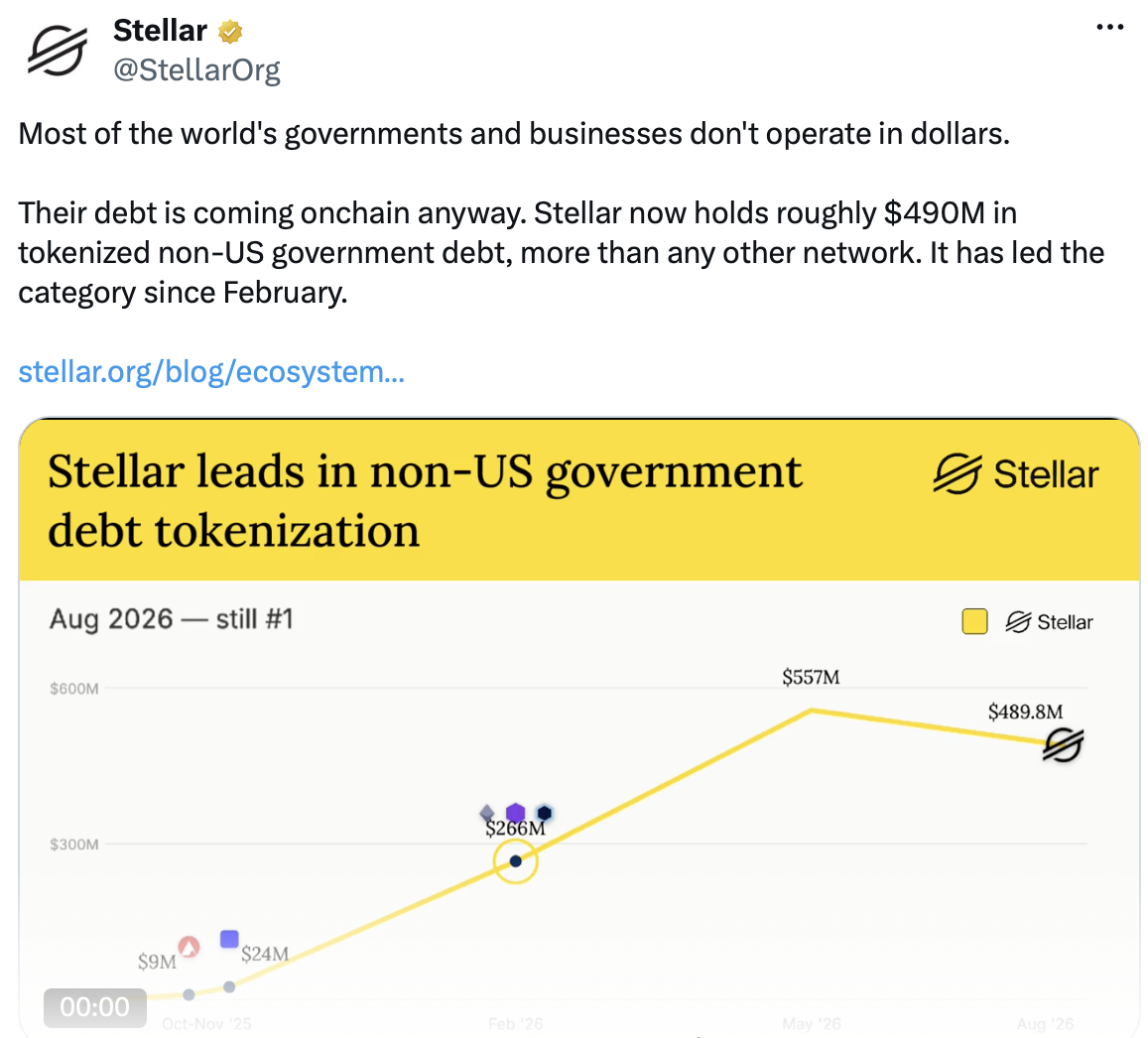
Stellar has also made considerable strategic inroads into non-US government debt, an area where its low-cost and fast transaction capabilities offer a distinct competitive advantage for cross-border transactions. Citing data from RWA.xyz, the Stellar Development Foundation reported that the network held approximately $490 million in this asset class as of August 20. This includes the successful tokenization of Mexican CETES (Certificados de la Tesorería de la Federación) and Brazilian government bonds, facilitated through innovative platforms like Etherfuse. The ability to tokenize sovereign debt from emerging markets on Stellar opens new avenues for these nations to access international capital markets more efficiently, bypassing traditional intermediaries and reducing issuance costs. For global investors, it provides easier access to diversified sovereign debt portfolios with enhanced transparency and liquidity, aligning perfectly with Stellar’s foundational mission to connect the world’s financial systems.
Key Issuers Driving Stellar’s RWA Market
The concentration of Stellar’s RWA market among a handful of prominent issuers underscores the strategic partnerships and significant capital flows into the network. As of August 27, Spiko led the charge, accounting for a substantial $1.55 billion of Stellar’s total RWA value. Spiko’s significant contribution highlights its role as a major facilitator or issuer within the Stellar ecosystem, likely specializing in bringing substantial asset portfolios on-chain.
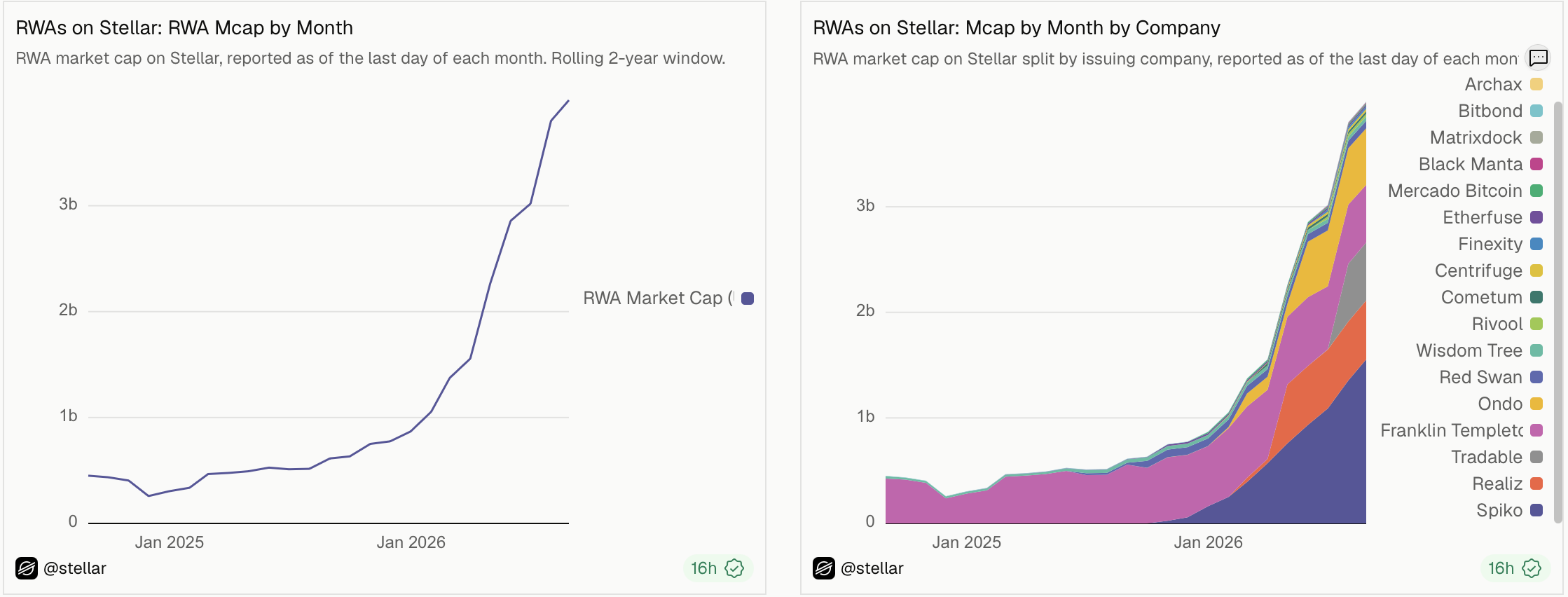
Following Spiko, Realiz contributed $559 million, Tradable $548 million, Franklin Templeton $546 million, and Ondo $535 million. These figures reveal a competitive landscape where both established financial giants and specialized tokenization platforms are actively leveraging Stellar’s robust infrastructure. Franklin Templeton, a global investment management organization with trillions in assets under management, lends considerable credibility and institutional weight to the network’s RWA initiatives. Their presence signifies a major endorsement from traditional finance. Ondo Finance, known for bridging traditional finance yields to decentralized finance (DeFi), brings its expertise in structuring tokenized products like US Treasurys and other fixed-income assets to the Stellar platform. The strong showing from these diverse players indicates a mature and serious approach to RWA tokenization on Stellar, attracting both capital and expertise.
Institutional Adoption: The Main Catalyst for Growth
The staggering growth in Stellar’s RWA market is not merely a statistical anomaly but a direct consequence of deepening engagement from significant financial institutions and specialized tokenization platforms. This institutional adoption is the bedrock upon which Stellar’s RWA boom is built, signaling a profound shift from experimental blockchain use cases to mainstream financial integration.
A pivotal moment that reverberated across the financial world occurred in May when the Depository Trust & Clearing Corporation (DTCC), a cornerstone of the global financial system responsible for clearing and settling trillions of dollars in securities transactions daily, announced its ambitious plans to integrate its tokenization service with Stellar. This is a transformative development. The DTCC’s integration, anticipated to go live in the first half of 2027, has the potential to onboard an unprecedented volume of traditional assets onto the Stellar network. The scope of this integration is vast, with expectations that it could eventually support tokenized US Treasurys, major index Exchange Traded Funds (ETFs), and even a significant portion of stocks listed in the prestigious Russell 1000 index. For Stellar, this represents monumental validation of its enterprise-grade capabilities and its suitability for handling the rigorous demands of institutional finance. The DTCC’s move underscores a growing recognition within traditional finance of blockchain’s potential to revolutionize securities markets, and Stellar is clearly positioned as a preferred partner in this critical transformation.
Adding to this powerful institutional momentum, July saw the tokenization platform Tradable announce its ambitious plans to bring up to $1 billion in private credit assets to Stellar. Tradable’s decision to leverage Stellar for this significant undertaking is particularly telling. The integration is meticulously designed to support comprehensive compliance frameworks, streamline investor onboarding processes, and facilitate efficient asset lifecycle management for these complex private credit instruments. This builds upon Tradable’s already impressive track record of tokenizing $1.7 billion in private credit across nearly 30 positions on other platforms, indicating their profound confidence in Stellar’s ability to handle sophisticated financial products with the necessary security and regulatory adherence. The move by Tradable further solidifies Stellar’s reputation as a reliable and scalable network for institutional-grade tokenization solutions, particularly for less liquid and more complex asset classes.
Beyond RWAs: Payments and a Robust Stablecoin Ecosystem
While tokenized RWAs are a major growth engine, Stellar’s foundational role in digital payments and its robust stablecoin ecosystem continues to expand, complementing and reinforcing its tokenization efforts. In June, MoneyGram, a global leader in cross-border peer-to-peer payments, launched its MGUSD dollar stablecoin on the Stellar network. This initiative allows users to hold dollar-denominated balances on-chain and seamlessly move funds through MoneyGram’s vast global payments network. The MGUSD stablecoin leverages Stellar’s inherent efficiency to provide a faster, cheaper, and more accessible way for individuals and businesses to conduct international remittances and payments, aligning perfectly with Stellar’s original mission.
The introduction of MGUSD further bolsters Stellar’s already robust stablecoin ecosystem. According to the same Dune dashboard, the network currently hosts approximately $438 million in reserve-verified stablecoins. The emphasis on "reserve-verified" is critical, as it speaks directly to the transparency, auditability, and trust embedded in these digital assets. These stablecoins, backed by audited reserves, provide a reliable and stable medium of exchange on the Stellar network, facilitating liquidity for RWA trading and general digital payment flows. This strong stablecoin infrastructure is essential for the seamless operation and continued growth of any tokenized asset market, providing the necessary on-ramps and off-ramps between traditional fiat currencies and digital assets.
XLM Token Performance: A Nuance in Network Growth
Despite the phenomenal growth across its RWA and stablecoin sectors, Stellar’s native cryptocurrency, XLM, has experienced a somewhat detached performance in the broader market. CoinGecko data indicates that XLM is down approximately 11% year-to-date, trading near $0.18. This apparent disconnect between significant network utility and token price action is a common, albeit often perplexing, theme in the cryptocurrency space and warrants further examination.
Several factors could contribute to this divergence. Firstly, while institutional adoption of the Stellar network for RWA tokenization and stablecoin issuance is robust, the direct utility of the XLM token for these specific applications might be primarily limited to covering nominal transaction fees and maintaining minimum account balances. The core value being transferred and stored on-chain in these instances is the tokenized asset itself (e.g., a tokenized bond or a stablecoin), rather than XLM. Secondly, broader cryptocurrency market sentiment, macro-economic conditions, and speculative trading often exert a more dominant influence on short-term token price movements than specific underlying network adoption metrics, especially for established tokens like XLM which have a significant retail trading presence. However, from a long-term perspective, increased network activity and deep institutional integration inevitably strengthen the underlying fundamentals of a blockchain. As more RWAs are tokenized and more stablecoins are issued, the demand for Stellar’s network resources grows, potentially increasing the scarcity value and intrinsic utility of XLM over time, even if indirectly. The expanding utility and powerful network effects fostered by these partnerships lay a solid foundation for future appreciation, even if current market dynamics don’t immediately reflect the network’s operational success.
Conclusion and Future Outlook
Stellar’s journey in 202