anjir abdul
A Solana-based token, branded as "Trump Digital GOLD" (GOLD), collapsed dramatically within hours of its launch, igniting a firestorm of questions regarding its origins, the entities behind its promotion, and highly unusual trading patterns that point towards a potential "rug pull" scheme. The token’s rapid demise has cast a fresh shadow over the intersection of political endorsements and the volatile world of cryptocurrency, raising concerns about investor protection and the integrity of digitally marketed assets.
The ill-fated token was aggressively promoted by "Real Trump Coins," a brand that US President Donald Trump himself publicly endorsed in 2024 for a separate venture involving silver medallions. Real Trump Coins leveraged its presence on X (formerly Twitter) to tout the "Trump Digital GOLD" token, before swiftly deleting all related promotional posts on Saturday, as meticulously documented by the blockchain analytics platform Lookonchain. Despite the removal of the social media advertisements, the Real Trump Coins website continued to promote GOLD as of the time of publication, featuring an advertised 4% trading fee and an ambitious pledge to utilize 99% of these fees to repurchase the token, with the stated aim of propelling it into the top 10 crypto assets by market capitalization.
This sudden launch and even swifter collapse have plunged the crypto community into a state of intense speculation and skepticism regarding GOLD’s legitimacy and the true identity of its creators. Many observers have voiced concerns, with some going so far as to suggest that the Real Trump Coins X account itself may have been compromised, used without authorization to push the now-defunct token. The incident underscores the inherent risks in the decentralized finance (DeFi) space, particularly when projects are perceived to have links, however tenuous, to high-profile public figures.
The saga of the GOLD token began to unfold early on a Saturday morning when the Real Trump Coins X account, notably followed by Trump’s official X account, announced the token’s launch. The post directed eager users to RealTrumpCoins.com for immediate purchase, setting the stage for what would soon become a textbook example of a crypto "rug pull." Blockchain analytics firm Lookonchain wasted no time in flagging the suspicious activity shortly after the launch. Their initial analysis revealed a highly concentrated distribution of the GOLD token: the developer wallet held a staggering 600 million GOLD tokens, while an additional 15 newly created wallets collectively spent $18,657 to acquire another 224.5 million tokens. This meant that, from the outset, the "team" or developers controlled an overwhelming 82.45% of the total supply, a critical red flag that savvy crypto investors are often warned to watch for. Lookonchain, recognizing the immediate danger, advised users to exercise extreme caution.
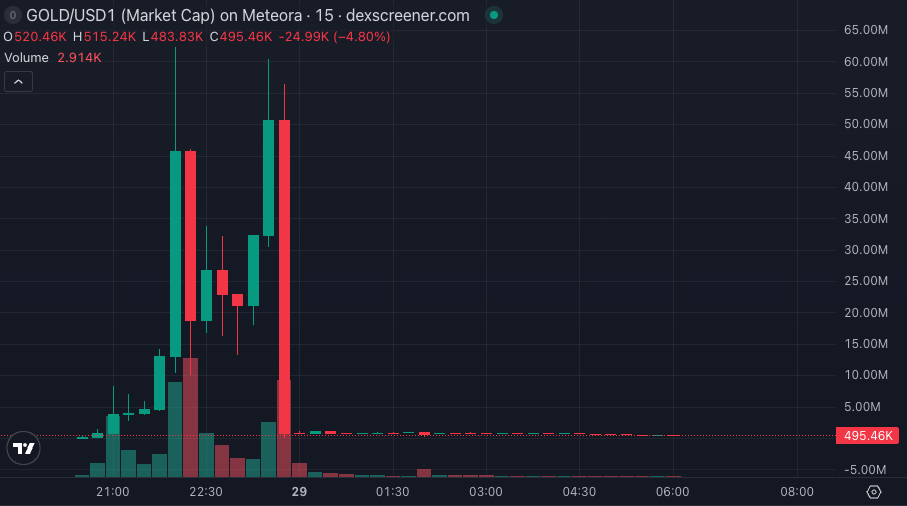
The caution proved prescient. Shortly thereafter, Lookonchain delivered another alarming update: the 15 wallets previously linked to the token’s "team" had systematically sold off all their 224.5 million GOLD tokens. This massive sell-off netted them 3,178 Solana (SOL), an amount valued at approximately $330,000 at the time. The immediate and predictable consequence was a catastrophic price crash for GOLD. The token’s market capitalization plummeted from an estimated $50 million to a mere $500,000 within a matter of hours, effectively wiping out nearly all of its value, according to data from DEX Screener. The term "rugged" was quickly applied by Lookonchain, signaling a classic "rug pull" where developers or early insiders liquidate their holdings, leaving retail investors with worthless assets. Lookonchain estimated that the involved wallets reaped a staggering profit of roughly $312,000, representing an approximate 17-fold return on their initial investment of $18,657. This rapid profit-taking at the expense of later investors is the hallmark of such illicit schemes.
The "Real Trump Coins" brand itself has a convoluted history within the broader narrative of Donald Trump’s engagement with digital assets and merchandise. Trump publicly endorsed RealTrumpCoins.com in September 2024 when he unveiled his series of silver medallions, explicitly designating the website as the sole authorized platform for purchasing these commemorative items. The website explicitly states that its products are not manufactured, distributed, or sold by the Trump Organization, attempting to create a legal distance. However, the direct public promotion by a former president and current presidential candidate lends an undeniable air of legitimacy to the associated brand, which can inadvertently extend to subsequent, potentially unauthorized, ventures.
The abrupt promotion of the GOLD token, followed by the swift deletion of its related X posts, fueled intense speculation across the crypto community regarding the integrity of the Real Trump Coins account. Solana community member Fabiano.sol openly claimed that the Real Trump Coins X account had been hacked, suggesting that an external malicious actor had gained control and used it to launch the fraudulent token. On-chain analyst EmberCN directly labeled GOLD as a "scam," echoing the sentiments of many who observed the suspicious trading patterns. Further heightening the drama, X user TITAN shared unsubstantiated claims that "Iranian hackers" were allegedly behind what they termed the "fake Trump launch," adding a geopolitical dimension to the unfolding mystery, though concrete evidence for such claims remained elusive. The lack of immediate clarity from Real Trump Coins itself only compounded the confusion and distrust.
This "GOLD episode" is not an isolated incident but rather another chapter in the growing scrutiny surrounding Trump-linked crypto ventures. As President Trump actively champions legislation aimed at reshaping US oversight of the cryptocurrency industry, his various connections to digital asset projects have come under increased scrutiny. On August 19, he urged lawmakers to pass a "fair version" of the CLARITY Act, proposed legislation designed to establish a clear regulatory framework for crypto assets, differentiating between securities and commodities. This push for regulatory clarity, while ostensibly beneficial for the industry, creates a potential conflict of interest given his family’s and his own involvement in numerous crypto initiatives.
Beyond Real Trump Coins, Trump and members of his family have either backed or launched several other crypto-related ventures. These include the widely discussed Official Trump (TRUMP) memecoin and World Liberty Financial. Such involvements have consistently drawn conflict-of-interest concerns, particularly as his administration seeks to influence crypto policy. Critics argue that his public support for specific brands or his family’s financial stakes in crypto projects could undermine the impartiality of any regulatory decisions made under his influence. The White House has, however, consistently denied any impropriety, asserting that these ventures are separate from official policy-making.
The broader implications of incidents like the GOLD token collapse extend beyond individual investor losses. They erode public trust in the burgeoning cryptocurrency market, particularly when high-profile names are even tangentially involved. Such events often invite increased regulatory attention, potentially leading to stricter oversight that could stifle innovation alongside curbing illicit activities. A report by Public Citizen, for instance, previously alleged that Trump’s various crypto "schemes" had cost investors billions of dollars, a claim that underscores the perceived financial risks associated with politically endorsed digital assets.
In conclusion, the swift rise and fall of "Trump Digital GOLD" serves as a stark reminder of the volatile and often unregulated nature of meme tokens and newly launched cryptocurrencies, especially those leveraging political affiliations. The incident highlights the critical importance of rigorous due diligence for investors, the inherent risks associated with highly concentrated token supplies, and the potential for social media accounts to be compromised for illicit purposes. While questions linger regarding the precise nature of the "Real Trump Coins" account activity – whether it was hacked, or if the brand was knowingly involved in a deceptive scheme – the outcome for early investors in GOLD was devastating. As the crypto landscape continues to evolve, intertwined with political discourse, the demand for transparency, accountability, and robust investor protections will only intensify. The GOLD incident adds another complex layer to the ongoing debate about the responsible integration of digital assets into the mainstream financial and political spheres.