anjir abdul
The recent shift in the aggregate profitability of Bitcoin holders offers a glimmer of hope amidst a prolonged period of market uncertainty. For the first time in a while, a majority of Bitcoin addresses are holding their assets at a price higher than their acquisition cost, indicating a general improvement in market sentiment and price action. However, discerning a genuine market reversal from a temporary bounce requires a deeper dive into sophisticated on-chain analytics, which provide insights into the behavior and positioning of various investor cohorts. Among the most crucial of these indicators are the "Bitcoin Supply in Profit (%)" and the "Long-Term Holder Spent Output Profit Ratio (LTH-SOPR)." These metrics, meticulously tracked by platforms like CryptoQuant, serve as barometers for the health and sustainability of market uptrends.
Bitcoin Supply in Profit: A Fragile Recovery Below Key Threshold
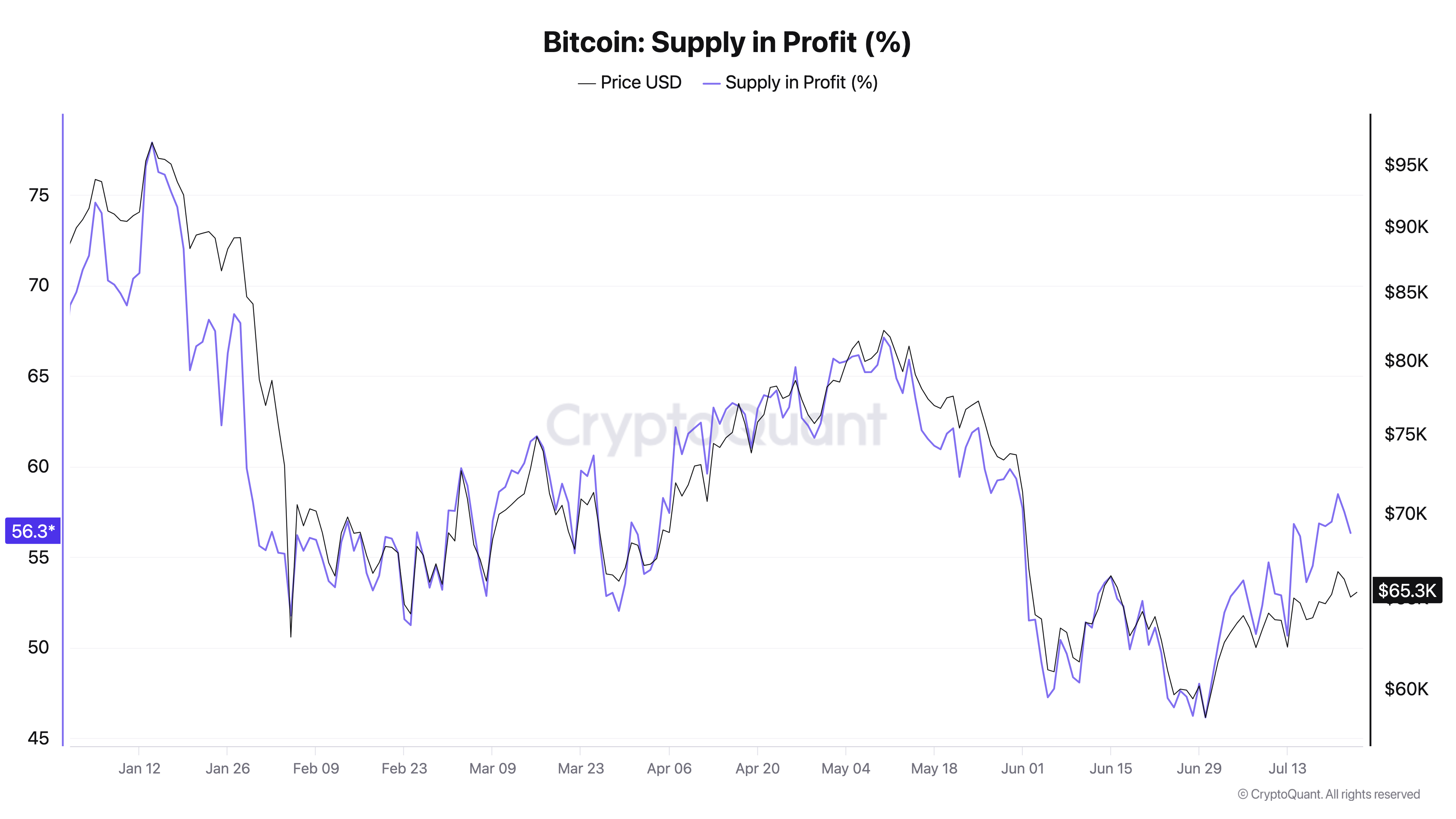
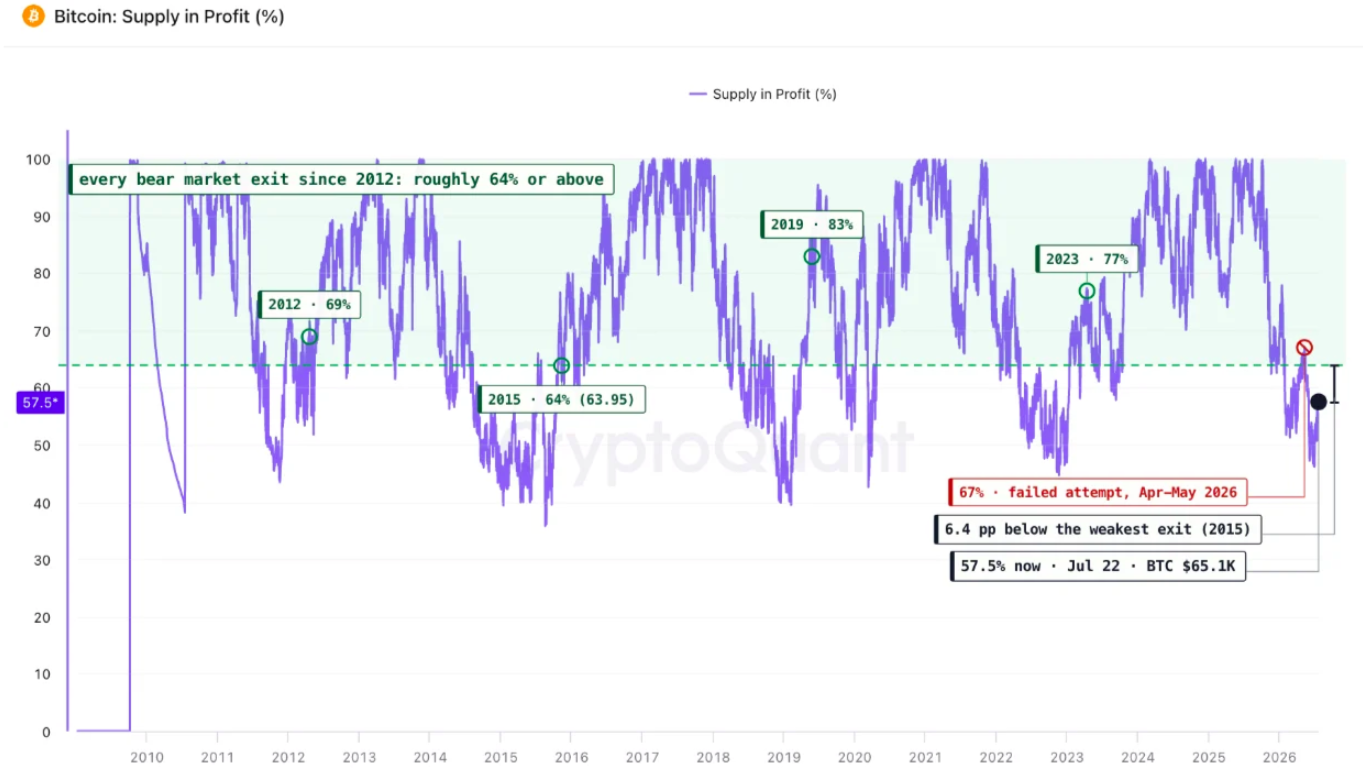
According to comprehensive data from the on-chain analytics platform CryptoQuant, the percentage of Bitcoin supply currently held in profit has shown a notable rebound since July. Specifically, the "Bitcoin Supply in Profit (%)," which represents the share of the total circulating Bitcoin supply whose current market value exceeds its last recorded acquisition price, climbed to 57.5% as of July 22. This marks a significant increase from its recent low of 46.2% recorded on June 30, signaling that more than half of all Bitcoin is now theoretically held at a profit. This metric is fundamental because it reflects the overall economic state of the Bitcoin market. When a larger portion of the supply is in profit, it often indicates increasing investor confidence and less selling pressure from those looking to exit losing positions.
However, the journey to a confirmed bull market or the definitive end of a bear cycle typically requires this metric to surpass a more substantial threshold. Historical analysis, as summarized by CryptoQuant contributor thechessONCHAIN, indicates that a robust market recovery usually sees the Bitcoin Supply in Profit consistently above 64%. The current level of 57.5%, while an improvement, still falls short of this critical mark. This discrepancy is precisely why caution remains paramount; the market has experienced similar upward movements in this metric before, only for them to prove temporary.
One such instance of a "false breakout" occurred earlier in the cycle. From April 28 to June 1, the Supply in Profit reached a peak of 67%, briefly surpassing the crucial 64% threshold. This period momentarily fueled optimism about a potential market turnaround. However, this surge was not sustained, and the metric subsequently rolled back over, falling below the key levels and indicating that the underlying market strength was not yet robust enough to maintain a sustained uptrend. This historical precedent underscores the importance of not just hitting, but consistently holding above, these significant profitability benchmarks. The current rebound, while positive, must demonstrate resilience and continued growth to avoid a similar fate.

Long-Term Holder SOPR: A Critical Indicator Still Signaling Caution
Complementing the "Supply in Profit" metric, the "Spent Output Profit Ratio (SOPR)" for long-term holders (LTHs) provides another vital layer of insight into market dynamics. LTHs are defined as entities that have held their Bitcoin dormant for a period of at least six months. This cohort is often considered the "strong hands" of the market, less susceptible to short-term price fluctuations and typically possessing a deeper conviction in Bitcoin’s long-term value. Their behavior, therefore, carries significant weight in determining the overall market trend.
The SOPR itself measures whether coins moving on-chain are being spent at a profit or a loss relative to their previous transaction price. A SOPR value above 1 indicates that, on average, coins are being spent at a profit, while a value below 1 suggests they are being spent at a loss. For LTHs, a sustained LTH-SOPR above 1 implies that these seasoned investors are increasingly taking profits, often seen during bull markets when prices are rising. Conversely, an LTH-SOPR below 1 signals that LTHs are realizing losses, which can be characteristic of capitulation phases during bear markets.
According to thechessONCHAIN’s analysis, a definitive end to a bear market and the confirmation of a new bull run typically requires the 30-day simple moving average (SMA) of LTH-SOPR to consistently remain above 1.0, without dipping below this critical level for an extended period of weeks. This sustained profitability for long-term holders signals that the market has absorbed selling pressure and is entering a phase of healthy appreciation.
However, the current situation presents a stark contrast to this requirement. While the overall "Supply in Profit" has improved, the 30-day SMA of LTH-SOPR has been languishing below 1 for more than 50 days. This indicates that, despite the aggregate profit increase, long-term holders are still, on average, realizing losses when they move their Bitcoin. This behavior is more indicative of a market still struggling to find solid ground rather than one embarking on a sustained uptrend.
Similar to the Supply in Profit metric, the LTH-SOPR also experienced a "failed attempt" earlier this year. From April 28 to June 1, precisely during the same period as the temporary surge in Supply in Profit, the LTH-SOPR average managed to hold above 1.0 for 35 days. This brief period of sustained LTH profitability, coupled with the high Supply in Profit, initially suggested a potential market recovery. However, the subsequent decline below 1.0 and its prolonged stay there confirm that the underlying conditions were not ripe for a lasting bull market, leading to another period of consolidation and uncertainty. The current prolonged period below 1.0 for the LTH-SOPR SMA highlights the fragility of the recent profitability boost and the continued need for caution.
The Interplay of Metrics and Historical Precedents
The critical takeaway from this on-chain analysis is the necessity for both the "Bitcoin Supply in Profit (%)" and the "Long-Term Holder SOPR (30-day SMA)" to meet their respective requirements simultaneously and consistently. Historically, bear markets have only truly concluded, and bull markets firmly established, when both metrics cross and sustain their respective thresholds: Supply in Profit above 64% and LTH-SOPR’s 30-day SMA above 1.0 for an extended period. The current situation, where one metric shows improvement but the other lags significantly, indicates that the market is still navigating a complex transition phase.
It’s also crucial to place these observations within the broader context of Bitcoin’s historical market cycles. As Cointelegraph previously reported, the Bitcoin supply in loss crossed the 50% mark in June. This threshold has historically been a potent signal, often preceding bear-market bottoms. When over half of the Bitcoin supply is underwater, it typically signifies widespread capitulation and the flushing out of weak hands, setting the stage for a potential reversal. The data from past cycles reveals striking similarities, with the 50% loss mark frequently initiating the "final countdown" to a BTC price cycle bottom. While this historical pattern offers a glimmer of optimism that the market may be nearing its trough, the subsequent recovery needs to be validated by the consistent bullish signals from profitability metrics like Supply in Profit and LTH-SOPR.
Demand Dynamics: A Mixed Picture
Beyond on-chain profitability, market demand provides further insights, presenting a mixed picture. On one hand, there appears to be weak spot-market interest. This often implies a lack of significant retail investor participation or strong organic buying pressure on exchanges, which can hinder a robust price rally. Without substantial spot demand, price increases can be more susceptible to volatility and less sustainable.
On the other hand, there has been a notable rebound in institutional Bitcoin allocation. This suggests that larger players, including asset managers and corporations, are increasingly re-engaging with Bitcoin, potentially viewing current price levels as attractive entry points for long-term positions. Institutional inflows into Bitcoin-related investment products, such as exchange-traded funds (ETFs) and trusts, can provide a significant underlying bid for the asset. However, the impact of institutional demand often plays out over longer timeframes and may not immediately translate into sustained spot market rallies if retail interest remains subdued. The recent end of a seven-day inflow streak for Bitcoin ETFs, following a $225 million outflow, further highlights the fluctuating nature of institutional interest, reinforcing the mixed demand narrative.
Outlook and Conclusion
The current state of Bitcoin profitability, while improved, is a delicate balance between encouraging signs and lingering uncertainties. The aggregate profit among investors is a positive development, indicating a shift from widespread losses. However, the failure of key metrics like the "Supply in Profit (%)" to consistently surpass the 64% threshold and the "Long-Term Holder SOPR (30-day SMA)" to remain above 1.0 for an extended period underscores the market’s fragility.
Should these metrics eventually and consistently breach their respective breakeven lines, it would provide strong technical confirmation of a sustained market recovery and potentially signal the start of a new bull market phase. This would likely be accompanied by increased trading volume, renewed investor confidence, and a more robust price appreciation. Conversely, if these metrics fail to hold their ground or fall back, it could indicate that the market is still in a consolidation phase, risking further price declines or a prolonged period of sideways movement. This scenario might necessitate a retesting of previous lows as the market searches for a more definitive bottom.
Ultimately, while the recent uptick in Bitcoin profitability is a welcome development for investors, the cautious stance adopted by on-chain analysts is well-founded. The market is not yet out of the woods, and the path to a confirmed bull run requires more than just a temporary boost in aggregate profits. It demands sustained strength across multiple key indicators, particularly those reflecting the behavior of long-term holders and the overall supply’s profitability above critical breakeven levels. Investors are encouraged to conduct independent research and exercise caution, as all investments and trades carry inherent risks.