anjir abdul
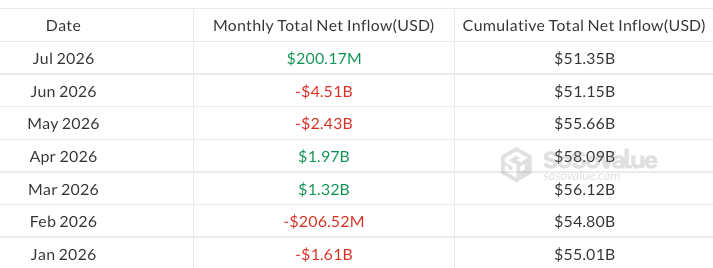
US-listed spot Bitcoin exchange-traded funds (ETFs) have registered their second consecutive week of net inflows, signaling a potential shift in investor sentiment, though analysts caution that the current momentum may not be robust enough to ignite a sustained market recovery. For the week ending July 17, these investment vehicles attracted a net $75.7 million, according to data compiled by SoSoValue. This positive streak follows a stronger inflow of $197.4 million in the preceding week, collectively pushing July’s total net inflows for Bitcoin ETFs to $200.2 million. While these figures offer a glimmer of hope, they stand in stark contrast to the severe downturn experienced in June, which saw a staggering $4.5 billion in net outflows, marking it as the worst month on record for these products. Consequently, the cumulative net flows for US spot Bitcoin ETFs in 2024 remain deeply in the red at negative $5.2 billion, highlighting the significant ground that needs to be recovered.
The return of positive flows, however modest, is being interpreted by market observers as an indication that the intense selling pressure that characterized the early summer months might be gradually subsiding. This easing of liquidation events or profit-taking by early investors could pave the way for a more stable market environment. Yet, the consensus among analysts is that the current pace of buying activity is still too limited to confirm a definitive broader uptrend. Institutional investors, whose participation was initially heralded as a major catalyst for Bitcoin’s price appreciation following the ETF launches in January, appear to be treading cautiously, awaiting clearer market signals and perhaps more favorable macroeconomic conditions.
This two-week period of net inflows coincided with Bitcoin’s price attempting to recover from its June lows, moving back towards the $64,000 mark. However, despite this upward movement, experts like Simon-Peter Massabni, head of business development at XS.com, emphasize that the recovery has yet to demonstrate the "real strength" necessary for a confirmed trend reversal. Massabni articulated to Cointelegraph that for a new uptrend to be decisively established, Bitcoin’s price would need to "decisively break above the $65,000–$65,500 range." This price level is considered a critical resistance point, and a firm breach would likely trigger further bullish momentum, drawing in more institutional and retail capital. The current market action, while positive, is largely seen as a bounce within a broader consolidation phase rather than a clear breakout.

The psychological and technical significance of the $65,000-$65,500 range cannot be overstated. From a technical analysis perspective, this zone represents a confluence of previous support and resistance levels. A decisive move above it, ideally supported by increasing trading volume, would invalidate bearish patterns and signal a potential shift in market structure. From a psychological standpoint, reclaiming this level would likely instill greater confidence among investors, particularly those who might have bought at higher prices earlier in the year. The Crypto Fear & Greed Index, which measures market sentiment, has hovered in the "Neutral" or "Greed" territory during this period, suggesting a cautious optimism rather than outright euphoria. Massabni further elaborated on the nuance of the recent inflows, stating, "Four consecutive sessions of inflows should be interpreted as a sign that selling pressure is easing, rather than clear evidence that institutional investors have returned on a broad scale." This distinction is crucial, as a mere reduction in selling is different from a strong, conviction-driven buying spree.
Adding to the cautious sentiment, Citigroup recently made a significant revision to its Bitcoin ETF outlook, underscoring the concerns over the actual strength of institutional demand. On July 1, Citi drastically cut its 12-month ETF inflow forecast from an optimistic $10 billion down to zero. This dramatic reduction reflects the bank’s revised expectations following weaker-than-anticipated flows and the substantial outflows observed in recent months. In tandem with this, Citi also lowered its 12-month Bitcoin price target from $112,000 to a more conservative $82,000. Such a significant downgrade from a major financial institution can influence broader market perceptions and institutional allocation strategies. Massabni echoed the sentiment that while "the market does not lack reasons to start buying Bitcoin," what is "still missing is a sufficiently strong catalyst – most likely a flow of capital large and persistent enough to turn the current rebound into a genuine trend." This catalyst could take many forms, from clearer macroeconomic signals like interest rate cuts, to further regulatory clarity, or even a major technological development within the Bitcoin ecosystem.
The journey of Bitcoin ETFs since their groundbreaking launch in January has been a rollercoaster. Initially met with immense enthusiasm, they saw record-breaking inflows in their first few months, propelling Bitcoin to new all-time highs. BlackRock’s IBIT and Fidelity’s FBTC, among others, quickly accumulated billions in assets under management, demonstrating strong initial appetite from both retail and institutional investors. However, the initial euphoria gave way to profit-taking and broader market corrections, leading to the substantial outflows observed in May and June. The Grayscale Bitcoin Trust (GBTC), in particular, experienced consistent outflows as investors converted from its higher-fee trust structure to lower-fee spot ETFs or simply exited their positions. This period of market adjustment is not entirely unprecedented for novel investment products.
Bloomberg ETF analyst Eric Balchunas provided a valuable historical perspective by comparing Bitcoin ETFs’ trajectory to that of gold ETFs. Gold ETFs, introduced in the early 2000s, also experienced rapid adoption and significant price appreciation for gold in their early years, followed by periods of consolidation, drawdowns, and subsequent recoveries. Balchunas highlighted that both products tend to exhibit similar patterns of "spectacular gains, painful drawdowns and recoveries," with each successive cycle potentially setting "higher highs over time." This comparison suggests that the current volatility and mixed flow data might be part of the natural maturation process for a new asset class integrating into traditional financial markets. The long-term view, as suggested by Balchunas, implies that despite short-term fluctuations, Bitcoin ETFs could eventually mirror gold ETFs in becoming a staple for diversification and inflation hedging in investor portfolios.
The broader macroeconomic landscape also plays a crucial role in shaping investor behavior towards risk assets like Bitcoin. Persistent inflation concerns, evolving interest rate policies from central banks like the Federal Reserve, and geopolitical uncertainties all contribute to a cautious investment environment. When traditional markets face headwinds, investors often de-risk, pulling capital from more volatile assets. Conversely, signals of economic stability or monetary easing could serve as the "sufficiently strong catalyst" Massabni referred to, encouraging a renewed flow of capital into Bitcoin ETFs. Furthermore, the regulatory environment continues to evolve. While spot Bitcoin ETFs are a reality in the US, discussions around spot Ethereum ETFs are ongoing, and potential approvals could further legitimize the broader digital asset space, potentially benefiting Bitcoin indirectly.
In conclusion, while the recent two-week streak of inflows into US spot Bitcoin ETFs is a welcome sign after a challenging period, it remains to be seen if this marks a genuine turning point or merely a temporary reprieve. The relatively modest figures, combined with the significant cumulative outflows for the year, underscore the cautious sentiment prevailing in the market. Analysts’ calls for a decisive break above $65,000-$65,500 and the need for a sustained, strong catalyst suggest that the path to a robust recovery is still unfolding. The comparisons to gold ETFs offer a long-term perspective, hinting at a future where Bitcoin, through its accessible ETF products, could establish itself as a more mature and integral component of global investment strategies, albeit one that is prone to significant volatility in its early stages of widespread adoption. The coming weeks will be crucial in determining whether this nascent positive trend can gather the necessary momentum to reverse the year’s negative trajectory and solidify Bitcoin’s position as a preferred asset for institutional and retail investors alike.