Imroatul Nasiyah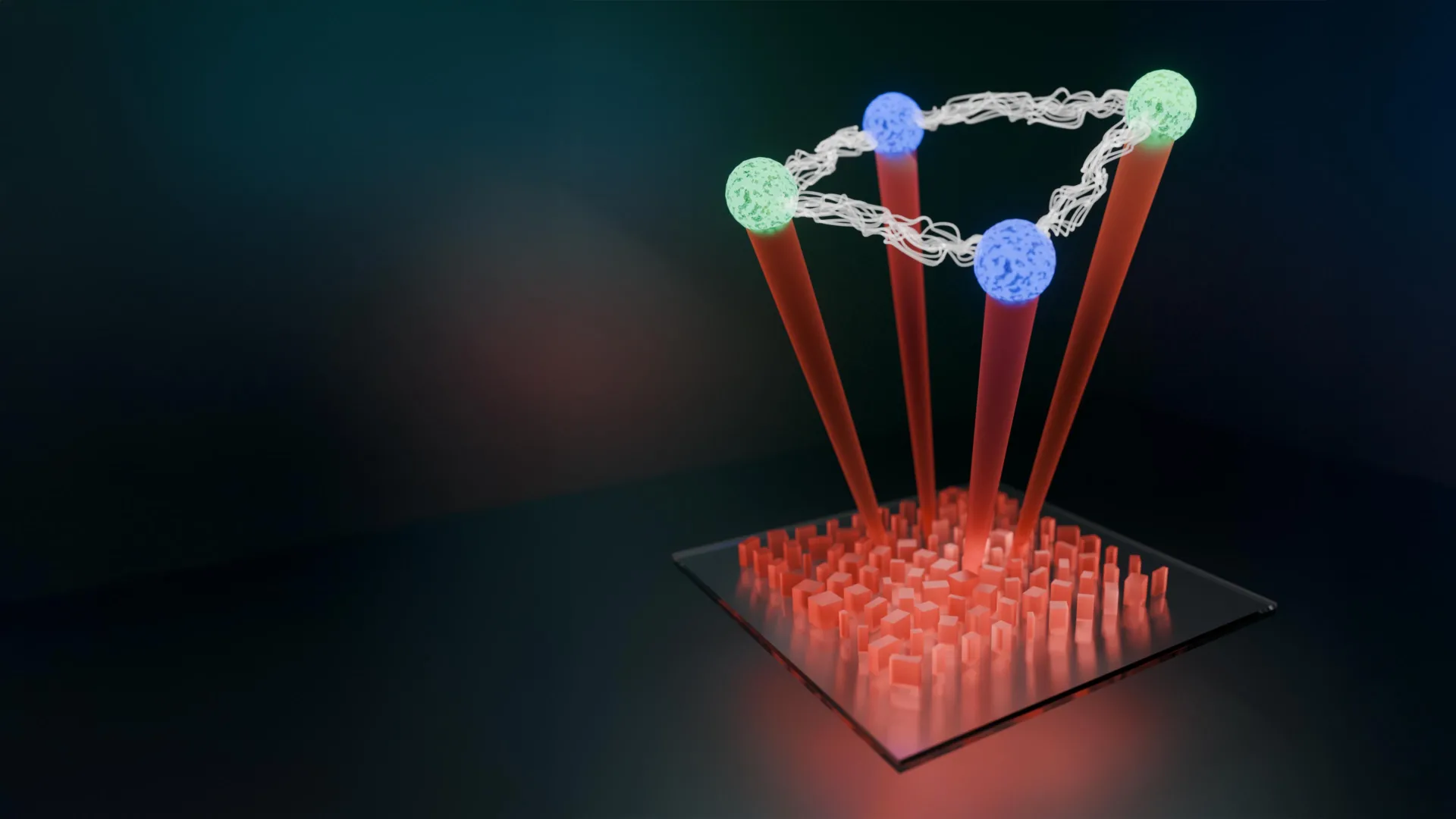
In a breakthrough that promises to fundamentally alter the landscape of quantum computing and networking, researchers at the Harvard John A. Paulson School of Engineering and Applied Sciences (SEAS) have engineered an ultra-thin chip that could overcome the long-standing scalability challenges plaguing photonic quantum systems. This innovation, detailed in a groundbreaking publication in the prestigious journal Science, introduces a paradigm shift by collapsing complex optical setups, previously reliant on bulky lenses, mirrors, and intricate waveguide networks, into a single, compact, and remarkably robust metasurface. This advancement not only heralds a new era for room-temperature quantum information processing but also holds immense potential for quantum sensing and the development of "lab-on-a-chip" systems for fundamental scientific exploration.
The pursuit of practical quantum computers and networks has long been captivated by the potential of photons, the fundamental particles of light. Their ability to act as swift carriers of information at ambient temperatures makes them exceptionally attractive for encoding and processing quantum data. However, harnessing photons for quantum entanglement – the phenomenon where particles become intrinsically linked and can perform computations in parallel – has traditionally been a cumbersome undertaking. Existing methods involve manipulating photons through extensive waveguide arrays etched onto microchips or employing elaborate assemblies of discrete optical components. These complex networks, while functional, suffer from a critical limitation: their sheer size and the inherent imperfections of numerous constituent parts make them exceedingly difficult to scale up for meaningful quantum computations or widespread networking. The question that has loomed large over this field is whether these disparate optical elements could be consolidated into a singular, flat, ultra-thin array of subwavelength structures capable of replicating their intricate light-controlling functions with vastly reduced fabrication complexity.
The answer, it appears, is a resounding yes. The team, spearheaded by Federico Capasso, the Robert L. Wallace Professor of Applied Physics and Vinton Hayes Senior Research Fellow in Electrical Engineering, has successfully engineered precisely designed metasurfaces. These are not conventional optical components; rather, they are flat devices meticulously etched with nanoscale patterns engineered to interact with and control light. These metasurfaces are now poised to serve as ultra-thin, highly efficient upgrades for existing quantum-optical chips and setups. The significance of this achievement lies in the demonstration that a single metasurface can effectively generate and manipulate complex, entangled states of photons, thereby performing quantum operations that were previously the domain of much larger, multi-component optical systems.
"We’re introducing a major technological advantage when it comes to solving the scalability problem," stated graduate student and first author Kerolos M.A. Yousef. His sentiment underscores the profound implications of this research. "Now we can miniaturize an entire optical setup into a single metasurface that is very stable and robust." This statement encapsulates the core benefit: a dramatic reduction in size, complexity, and susceptibility to environmental disturbances, all while enhancing performance.
The research findings illuminate the distinct possibility of creating optical quantum devices that diverge significantly from conventional approaches. Instead of relying on the notoriously difficult-to-scale waveguides and beam splitters, or even extended optical microchips, these novel devices leverage the inherent advantages of error-resistant metasurfaces. These advantages are manifold, including designs that obviate the need for intricate alignments, a remarkable robustness against perturbations, cost-effectiveness stemming from simpler fabrication processes, and crucially, low optical loss, which is paramount for maintaining the delicate quantum states of photons. In essence, this work pioneers the field of metasurface-based quantum optics. Beyond carving a direct path toward the realization of room-temperature quantum computers and networks, this technological leap also promises to significantly benefit quantum sensing applications, enabling unprecedented precision in measurement, and to offer sophisticated "lab-on-a-chip" capabilities for fundamental scientific research, allowing complex optical experiments to be conducted on a miniaturized platform.
The design of a single metasurface capable of finely controlling crucial photonic properties such as brightness, phase, and polarization presented a formidable challenge. This difficulty escalates dramatically as the number of photons, and consequently the number of qubits, increases. Each additional photon introduces a multitude of intricate interference pathways. In conventional optical setups, managing these pathways would necessitate a rapidly expanding number of beam splitters and output ports, quickly leading to an unmanageable increase in complexity and size.
To navigate this labyrinth of complexity, the research team turned to an elegant, yet unconventional, tool: graph theory. This branch of mathematics, which utilizes points and lines to represent connections and relationships, provided the conceptual framework to bring order to the intricate interactions of entangled photons. By representing entangled photon states as a network of interconnected lines and points, the researchers gained the ability to visually discern how photons interfere with each other. This graphical representation also proved invaluable in predicting the outcomes of experimental manipulations with remarkable accuracy. While graph theory is already employed in certain aspects of quantum computing and quantum error correction, its application in the design and operational principles of metasurfaces was a novel and transformative insight.
The collaborative nature of this research was instrumental to its success. The paper represents a significant joint effort with the laboratory of Marko Loncar, a leading expert in quantum optics and integrated photonics. Loncar’s team contributed essential expertise and access to specialized equipment, further bolstering the project’s capabilities.
"I’m excited about this approach, because it could efficiently scale optical quantum computers and networks — which has long been their biggest challenge compared to other platforms like superconductors or atoms," expressed research scientist Neal Sinclair, highlighting the competitive advantage of this photonic approach. He further elaborated on the broader implications: "It also offers fresh insight into the understanding, design, and application of metasurfaces, especially for generating and controlling quantum light. With the graph approach, in a way, metasurface design and the optical quantum state become two sides of the same coin." This evocative analogy underscores the deep synergy between the mathematical framework and the physical implementation, suggesting a unified understanding that could accelerate future discoveries.
The research received crucial support from federal funding agencies, notably the Air Force Office of Scientific Research (AFOSR) under award number FA9550-21-1-0312. This vital financial backing enabled the groundbreaking work to be performed at the state-of-the-art facilities of the Harvard University Center for Nanoscale Systems, a hub for cutting-edge research in nanotechnology and nanoscience. The successful development of these ultra-thin metasurfaces represents a significant leap forward, moving the dream of practical, scalable quantum computing and networking closer to reality and opening up exciting new avenues for scientific exploration and technological innovation.