Faris Adani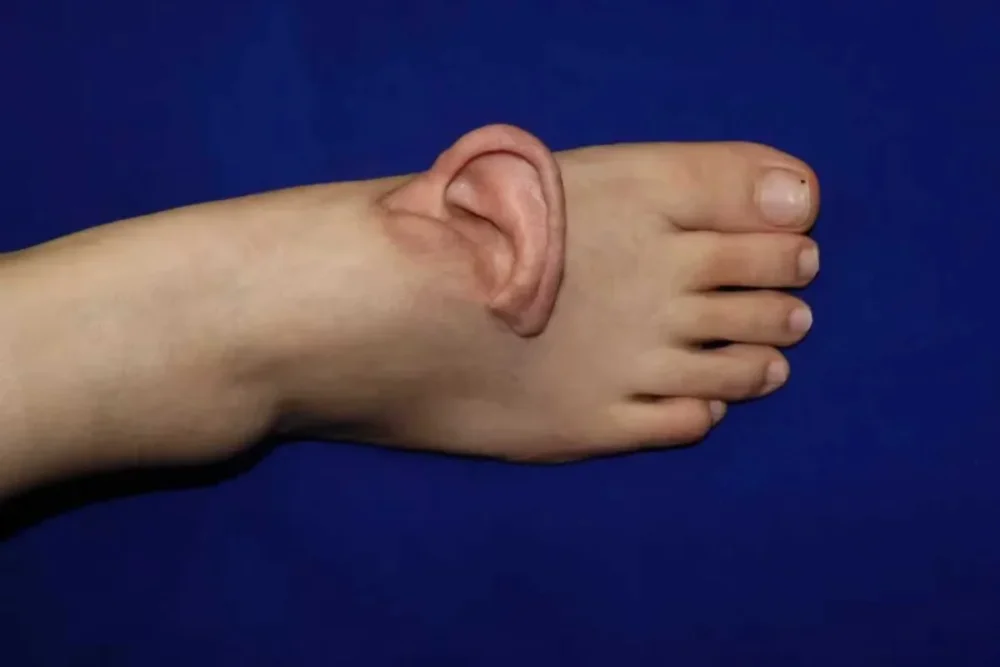
In a truly groundbreaking medical feat that pushed the boundaries of reconstructive surgery, doctors in China have achieved a global first by surgically grafting a patient’s severed ear onto her foot for temporary preservation before successfully reattaching it to her head. This extraordinary procedure, reported by the South China Morning Post, not only saved the patient’s ear but also illuminated the incredible ingenuity and meticulous skill present in modern microsurgery, offering new hope for victims of severe trauma.
The remarkable journey began with a horrific workplace accident. The patient, identified only by her surname Sun, endured a catastrophic incident involving heavy machinery. The industrial accident resulted in the complete avulsion of a significant portion of her scalp and, crucially, her entire ear. Such injuries are not only disfiguring but life-threatening, often involving massive blood loss and complex tissue damage. Sun’s case presented an immediate and formidable challenge to the medical team at Shandong Provincial Hospital in Jinan, led by Qiu Shenqiang, deputy director of the microsurgery unit.
Upon arrival, the severity of Sun’s injuries became starkly apparent. Her scalp, neck, and face had suffered extensive tearing, described by Qiu Shenqiang as being "split into multiple fragments." The ear, a delicate structure composed of cartilage, skin, and an intricate network of tiny blood vessels, was "completely severed along with the scalp." The immediate priority was to stabilize the patient and assess the viability of reattaching the ear. However, the sheer extent of the damage to her scalp and its underlying vascular network rendered immediate reattachment impossible. The skull itself needed time – potentially months – to heal sufficiently, and the damaged tissue around the original site was not conducive to supporting the ear’s delicate blood supply.
This presented the surgical team with a critical dilemma: how to preserve the severed ear for an extended period without it succumbing to necrosis. Conventional methods of preserving body parts, such as placing them on ice, are only viable for a few hours. For an organ to survive for months, it requires a continuous supply of oxygenated blood and nutrients, and the removal of waste products. This physiological necessity drove the team to consider a radical, unprecedented approach: a heterotopic graft.
Heterotopic grafting, while not entirely new in medicine, involves transplanting tissue or an organ from its usual anatomical site to another site on the same individual’s body (autograft) or to a different individual (allograft). This technique is commonly employed in procedures like skin grafting or in experimental settings for organ preservation. However, applying it to a severed ear, specifically to the foot, had no precedent in medical history. The decision to use the foot was not arbitrary; it was based on careful anatomical and physiological considerations. Qiu Shenqiang explained that the foot offered compatible arteries and veins with those found in the ear, crucial for establishing a viable blood supply. Furthermore, the skin and soft tissue of the foot are similarly thin to those of the head, providing a suitable environment for the ear’s delicate structure without excessive bulk or pressure.
Despite the theoretical soundness of the plan, the practical execution was fraught with immense risk. The operation to graft the ear onto Sun’s foot was a marathon, lasting an arduous ten hours. During this intricate procedure, the surgeons, employing specialized microsurgical techniques, meticulously connected the ear’s minuscule blood vessels – arteries to supply fresh blood and veins to drain deoxygenated blood – to the corresponding vessels in the patient’s foot. This demands exceptional precision, requiring the use of powerful operating microscopes and instruments finer than human hair, as the diameter of these vessels can be less than a millimeter. The success of this initial graft hinged entirely on establishing a functional vascular anastomosis, ensuring continuous blood flow to the transplanted ear.
The immediate aftermath of the surgery was a period of intense vigilance. The medical team monitored the ear on Sun’s foot round the clock, watching for any signs of rejection or vascular compromise. For five days, everything seemed to be progressing as hoped. However, a critical complication arose on the fifth day: the ear began to turn a purplish-black color. This alarming development signaled venous insufficiency, a common and dangerous issue in replantation and transplantation. It meant that while arterial blood was reaching the ear, the veins were struggling to drain the deoxygenated blood back to the heart, causing blood to pool within the ear’s tissues. Without intervention, this pooling would lead to tissue congestion, lack of oxygen exchange, and ultimately, necrosis and loss of the ear.
The medical team immediately sprang into action to salvage their groundbreaking work. Over the next five days, they embarked on a painstaking, labor-intensive process of manual bloodletting. This involved making tiny, controlled incisions into the ear tissue to allow the congested blood to drain, thereby relieving pressure and facilitating better circulation. This was not a one-time fix; it required almost five hundred individual interventions over that five-day period. Each intervention demanded meticulous care to avoid further damage to the delicate tissue while effectively restoring blood flow dynamics. This phase underscored not only the surgical skill but also the unwavering dedication and perseverance of the medical staff, who worked tirelessly to rescue the ear from certain demise.
Once the ear was stabilized and its viability secured, the focus shifted to the long-term recovery of Sun’s scalp. The five months that followed the initial foot graft were crucial for the extensive wounds on her head and neck to heal. During this period, the ear remained attached to her foot, a living testament to medical innovation, nurtured by the foot’s blood supply. The patient herself had to adapt to this unusual temporary appendage, a constant reminder of her trauma but also a beacon of hope for eventual restoration.
Finally, after five months of healing and preparation, the time came for the ear to be returned to its proper place. In October, the surgical team performed the second major procedure: detaching the ear from the foot and meticulously reattaching it to the side of Sun’s head. This second surgery was arguably as complex as the first, requiring the surgeons to reconnect the ear’s blood vessels to the now-healed and revascularized tissues of the scalp. The success of this stage depended on the health of both the preserved ear and the recipient site.
The outcome of this extraordinary medical journey has been overwhelmingly positive. The patient, Sun, has since been discharged from the hospital. The South China Morning Post reported that her face and tissue function have largely recovered, signifying a remarkable restoration of both form and, hopefully, some degree of function. While full auditory function might still be a long road, the preservation and successful reattachment of the ear represent a monumental achievement in reconstructive surgery.
This unprecedented case has profound implications for the future of trauma medicine and reconstructive surgery. It demonstrates the feasibility of using heterotopic grafting in highly complex scenarios to preserve critical body parts that would otherwise be lost. It opens new avenues for managing severe avulsion injuries where immediate replantation is not possible, offering a "holding pattern" for tissue survival. Furthermore, it highlights the continuous advancement in microsurgical techniques and the courageous spirit of medical teams willing to innovate and undertake procedures previously deemed impossible. The story of Sun’s ear is not just a tale of medical ingenuity; it is a testament to human resilience and the relentless pursuit of healing, pushing the boundaries of what is medically achievable and offering new hope to countless individuals facing similar life-altering injuries.