Faris Adani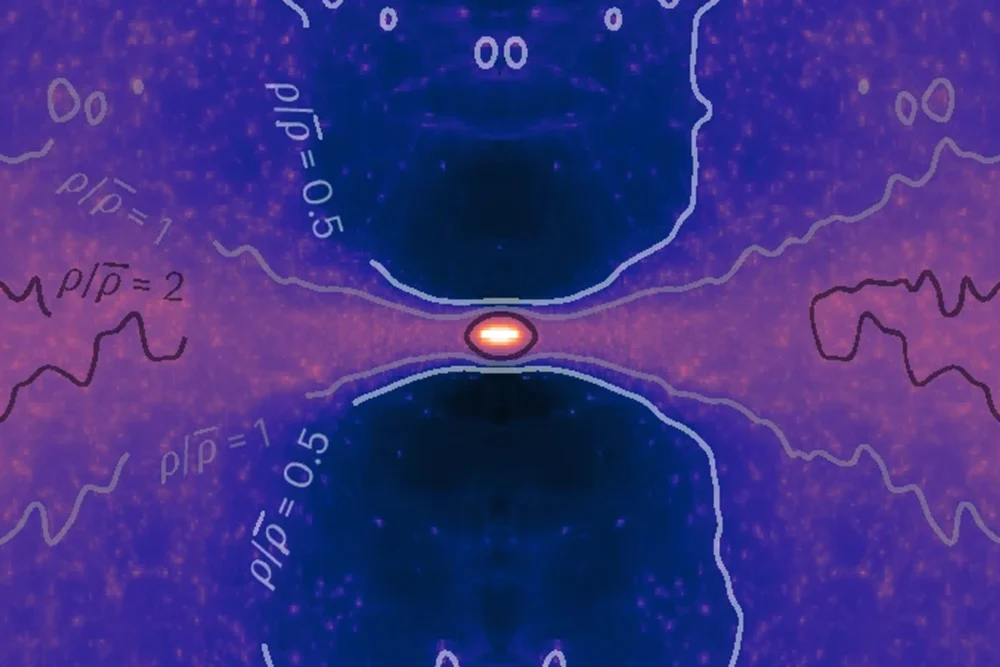
The Milky Way, along with its galactic companions forming the Local Group, appears to be deeply embedded within an immense, extended "sheet" of dark matter, flanked on either side by vast cosmic voids, according to groundbreaking new research. This remarkable discovery, detailed in a study recently published in Nature Astronomy, offers a compelling explanation for the perplexing, seemingly contradictory motions observed among our galactic neighbors, motions that have long defied conventional gravitational models.
For nearly a century, astronomers have grappled with the implications of Edwin Hubble’s seminal discovery: the universe is expanding, carrying nearly every galaxy away from us at a speed directly proportional to its distance. Yet, a significant anomaly persisted right on our cosmic doorstep: Andromeda, the largest galaxy in our Local Group and our closest major galactic neighbor, is hurtling towards the Milky Way, destined for a titanic collision billions of years from now. This inward trajectory, while seemingly straightforward in a gravitationally bound system, became part of a larger enigma. The Local Group—a collection of over 50 galaxies, including the Milky Way and Andromeda, all gravitationally tethered—should, in theory, be drawing all its members inward. However, observations reveal that many of the smaller galaxies within and around the Local Group exhibit motions that suggest they are being pulled outward, moving away from the gravitational center of the group, rather than towards it. This long-standing mystery has challenged astronomers to reconcile local galactic dynamics with the broader cosmological framework.
To unravel this intricate puzzle, researchers embarked on an ambitious project: creating a "virtual twin" of the Local Group and its surrounding galactic environment. This sophisticated simulation began by inferring the initial conditions of our cosmic neighborhood shortly after the Big Bang, drawing data from the cosmic microwave background (CMB)—the faint echo of the universe’s infancy. The CMB provides a snapshot of the universe when it was only about 380,000 years old, revealing the tiny fluctuations in temperature and density that would eventually seed the formation of all cosmic structures. Using these initial conditions, the scientists then ran an N-body simulation, essentially modeling the gravitational evolution of matter over billions of years, allowing them to trace how these primordial fluctuations developed into the galaxies and large-scale structures we observe today. By comparing the motions of the galaxies in their simulated universe to the observed motions of real galaxies, they could validate their model. The striking agreement between the virtual and actual galactic dynamics suggested their simulation accurately replicated the universe’s evolution in our local corner of space.
The pivotal revelation from this "virtual twin" experiment was that the only way to reconcile the observed galactic motions with the simulated evolution was if the entire Local Group resided within an immense, flat "sheet" of dark matter. This colossal structure, spanning millions of light-years, fundamentally alters our understanding of the local gravitational landscape. Dark matter, an invisible and still-hypothetical substance, is believed to constitute approximately 85 percent of all matter in the universe. Its existence was first hypothesized in the 1930s by astronomer Fritz Zwicky, who observed that galaxies in the Coma Cluster were moving too fast to be held together by their visible mass alone. Subsequent observations, such as the rotation curves of spiral galaxies (stars orbiting faster than expected based on visible matter) and gravitational lensing around galaxy clusters (the bending of light from background objects by massive foreground structures), have provided overwhelming indirect evidence for dark matter’s pervasive influence. It doesn’t interact with light or other electromagnetic forces, making it invisible, but its gravitational pull is crucial for holding galaxies and galaxy clusters together, acting as a cosmic scaffolding.
The standard cosmological model posits that entire galaxies are ensconced within vast, spherical clumps of dark matter, known as dark matter halos, which can contain trillions of times the mass of our Sun. These halos are traditionally imagined as roughly spherical distributions, providing a gravitational anchor for the visible matter within. However, the new research challenges this traditional, spherical view for our immediate galactic neighborhood, proposing instead a flat, sheet-like geometry. This distinction is critical. As the researchers explain, "In a sheet-like geometry, the velocity-distance relation depends not only on the enclosed mass, as in the spherical case, but also on the mass at larger distances." This means that the immense gravitational pull exerted by the dark matter extending out to the distant edges of this cosmic sheet is subtly pulling everything within it slightly outward. Furthermore, the presence of cosmic voids—vast regions of space with very few or no galaxies and very little matter—flanking this dark matter sheet would create a gravitational gradient, effectively "pushing" or "pulling" galaxies away from the denser sheet towards these underdense regions. This unique configuration provides a tidy and elegant explanation for the puzzling outward motions of many of our nearby galaxies, resolving a long-standing astronomical paradox.
Ewoud Wempe, the lead author of the study from the Kapteyn Institute in Groningen, Netherlands, emphasized the groundbreaking nature of this work. "We are exploring all possible local configurations of the early universe that ultimately could lead to the Local Group," Wempe stated, highlighting the comprehensive approach taken. "It is great that we now have a model that is consistent with the current cosmological model on the one hand, and with the dynamics of our local environment on the other." This consistency is paramount, as it bridges the gap between large-scale cosmic evolution and the intricate movements observed on a more localized scale.
This discovery holds profound implications for our understanding of dark matter and the formation of cosmic structures. If confirmed by further observations and simulations, it could refine our models of how dark matter halos are shaped and distributed, especially in regions like the Local Group. It suggests that while spherical halos might be the norm for isolated galaxies or larger clusters, more complex, anisotropic geometries like sheets could arise in specific cosmic environments, influenced by the surrounding large-scale structure of the universe, often referred to as the cosmic web—a vast network of filaments, clusters, and voids.
Future research will undoubtedly focus on seeking observational evidence to corroborate this hypothesis. Precise measurements of galactic velocities, combined with advanced gravitational lensing studies, could help map the distribution of dark matter in and around the Local Group with unprecedented detail. This could involve using next-generation telescopes and surveys to observe faint distortions in background light caused by the gravitational effects of this proposed dark matter sheet. Furthermore, the finding could guide the development of new theoretical models for dark matter, potentially influencing experimental efforts to directly detect dark matter particles on Earth. The elusive nature of dark matter means every new piece of information about its distribution and behavior is a critical step towards unraveling one of the universe’s greatest mysteries. The idea that our entire galactic neighborhood is surfing on a colossal, invisible wave of dark matter provides a captivating new perspective on our place in the cosmos.