anjir abdul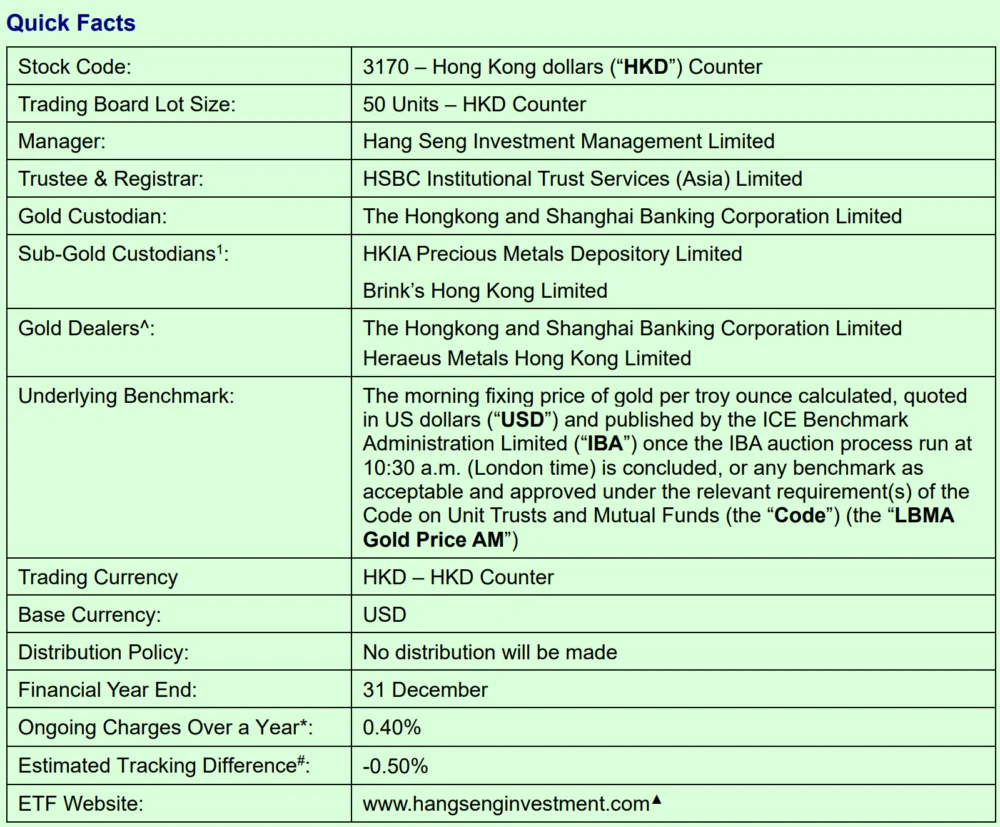
The Hang Seng Gold ETF, which commenced trading on the Hong Kong Stock Exchange on Thursday under the stock code 3170, represents a robust offering for investors seeking exposure to the precious metal. Designed to meticulously track the LBMA Gold Price AM, the globally recognized morning benchmark established in London, the fund offers a transparent and liquid investment vehicle. Its structure as a passive ETF ensures that its performance closely mirrors that of physical gold, minimizing active management risks. Crucially, the fund is physically backed, meaning it holds actual gold bars that adhere to the stringent London Bullion Market Association (LBMA) good delivery standards, providing investors with tangible security behind their holdings. These gold reserves are securely stored in high-security vaults located within Hong Kong, with HSBC, a global banking behemoth, appointed as the gold custodian, underscoring the fund’s commitment to robust asset safeguarding and institutional-grade infrastructure.
The operational mechanics of the Hang Seng Gold ETF allow for both in-cash and, under specific conditions, in-gold creation and redemption processes for participating dealers. This flexibility is vital for maintaining the fund’s arbitrage mechanism, which helps keep the ETF’s market price aligned with its net asset value. Retail investors, however, engage with the fund by trading units on the secondary market, much like conventional shares, benefiting from the ease and accessibility of exchange-listed products. The listed class of the ETF is denominated in Hong Kong dollars, with a board lot size of 50 units, making it accessible to a wide range of investors. Investors should note the estimated ongoing charge of 0.40% per annum and an estimated annual tracking difference of minus 0.50%, which are standard considerations for ETF investments. Furthermore, Hang Seng has clarified that the fund does not intend to distribute dividends, meaning that returns for investors will be solely contingent upon the movements in the underlying gold price, reflecting the intrinsic nature of investing directly in gold.
Beyond the conventional listed ETF, Hang Seng’s announcement includes groundbreaking plans for tokenized unlisted units of the identical fund. This forward-thinking initiative envisages a future where ownership interests in the gold fund are digitally represented and recorded on a blockchain infrastructure. While these tokenized units are not yet available to the public, their eventual launch remains a significant strategic objective, contingent upon securing the necessary regulatory approvals from relevant authorities. This cautious approach highlights the evolving regulatory landscape surrounding digital assets and Hang Seng’s commitment to compliance and investor protection.
In a pivotal development for the tokenization aspect, HSBC has been designated as the tokenization agent. In this capacity, HSBC will be responsible for issuing digital tokens that represent fractional or whole ownership of the fund units. Each token will correspond precisely to a unit, or a fraction thereof, of the underlying gold fund, ensuring a direct and transparent link between the digital asset and the physical gold it represents. All subscription and redemption transactions for these tokenized units will be meticulously recorded on a public blockchain, leveraging the inherent transparency and immutability of distributed ledger technology. The choice of blockchain platform is particularly noteworthy; according to the fund’s prospectus, "Initially, the Tokenisation Agent intends to utilise Ethereum as the primary blockchain. Other public blockchains with comparable level of security resiliency and distributed ledger technology may be adopted in future." This decision to start with Ethereum underscores its established position as a leading smart contract platform, favored by many institutional players for its robust security, extensive developer community, and proven track record in supporting complex financial applications. However, it also leaves room for future flexibility, acknowledging the dynamic nature of the blockchain ecosystem and potential advancements in other DLT platforms.
It is important for prospective investors to understand the current limitations of these planned tokenized units. While they offer the benefits of blockchain technology, they can only be subscribed to or redeemed through approved distributors. Crucially, there will be no secondary market trading for these tokenized units initially. This restriction aims to manage liquidity and regulatory compliance in the early stages of this innovative product, ensuring a controlled environment for its introduction into the market. Despite this limitation, the introduction of tokenized units represents a significant step towards democratizing access to institutional-grade assets and enhancing the efficiency of traditional financial products.
The timing of Hang Seng’s move is particularly pertinent, coinciding with a period of heightened interest in gold. Gold prices surged another 4% on Thursday, propelling spot gold close to $5,530 an ounce for the first time in recent memory. This sharp ascent reflects a global trend where investors are increasingly seeking safe-haven assets amidst escalating economic uncertainties, inflationary pressures, and geopolitical instability across various regions. The inherent value and historical stability of gold make it an attractive hedge against market volatility and currency depreciation, further underscoring the relevance of a new, accessible gold investment product.

Hang Seng’s initiative is not an isolated event but rather part of a broader, accelerating trend within the financial industry towards the tokenization of traditional assets. Just last week, the New York Stock Exchange (NYSE), through its parent company Intercontinental Exchange (ICE), announced its own ambitious plans to develop a blockchain-based platform designed for the trading of tokenized stocks and ETFs. This platform aims to revolutionize market operations by offering 24/7 trading capabilities and near-instant settlement, a stark contrast to the traditional T+2 or T+3 settlement cycles. Such advancements, pending regulatory approval, promise to unlock unprecedented efficiencies and liquidity in global capital markets, transforming how securities are traded and settled.
Further emphasizing this industry shift, a recent report from Sygnum, a digital asset bank, highlighted that traditional financial institutions are steadily migrating towards blockchain-based infrastructure. Sygnum predicted that asset tokenization is poised to go mainstream by 2026, marking a pivotal inflection point for the financial sector. Mathias Imbach, co-founder and CEO of Sygnum, boldly forecasted that up to 10% of new bond issuance by major institutions could be tokenized at launch, signaling a significant paradigm shift in how debt instruments are created, managed, and traded. This widespread adoption is driven by the compelling advantages that tokenization offers, including fractional ownership, increased liquidity for illiquid assets, enhanced transparency, reduced settlement times, and lower operational costs by eliminating intermediaries and manual processes.
Other major players have also explored or committed to tokenized equities. Binance, a leading cryptocurrency exchange, has previously confirmed its plans for tokenized equity offerings, building on earlier pushes in this direction. Similarly, discussions around the potential for tokenized stocks from platforms like Robinhood have underscored the growing consensus that such innovations are "inevitable." Robinhood’s CEO has even suggested that tokenized stocks could help prevent trading freezes, a critical issue observed during periods of extreme market volatility, by enabling continuous, immutable, and transparent transactions on a blockchain.
The benefits of tokenization are multi-faceted and profound. By representing real-world assets as digital tokens on a blockchain, fractional ownership becomes inherently easier, allowing a broader range of investors to access high-value assets like real estate, art, or, in this case, gold. This dramatically increases market accessibility and liquidity. Furthermore, blockchain’s immutable ledger provides an unparalleled level of transparency and auditability, reducing fraud and increasing trust. The ability for near-instant settlement, as opposed to traditional multi-day cycles, significantly reduces counterparty risk and frees up capital more quickly, optimizing market efficiency. Despite these advantages, the path to mainstream tokenization is not without its challenges. Regulatory frameworks are still catching up to the pace of technological innovation, creating legal uncertainties. Interoperability between different blockchain networks and traditional financial systems remains a technical hurdle, and ensuring the robust security of digital assets against cyber threats is paramount.
Hang Seng’s foray into tokenized gold units also firmly places Hong Kong on the global map as a burgeoning hub for digital assets and fintech innovation. The Hong Kong government and regulators have expressed a clear intent to foster a vibrant ecosystem for virtual assets, balancing innovation with stringent investor protection. This strategic move by a prominent financial institution like Hang Seng, leveraging a widely adopted public blockchain like Ethereum, aligns perfectly with Hong Kong’s broader ambitions to remain a leading international financial center in the digital age. Ethereum, with its robust smart contract capabilities and extensive decentralized application (dApp) ecosystem, offers a highly secure and flexible platform for issuing and managing tokenized assets, making it a logical choice for institutional-grade projects.
In conclusion, Hang Seng Investment Management’s launch of its physically backed gold ETF with an eye towards tokenized units on Ethereum represents a significant milestone in the convergence of traditional finance and blockchain technology. It not only provides investors with a modern, efficient way to invest in gold but also paves the way for a future where a broader spectrum of assets could be tokenized, enhancing liquidity, transparency, and accessibility across global financial markets. As regulatory landscapes evolve and technological capabilities mature, initiatives like Hang Seng’s are crucial in shaping the future of finance, driving us towards a more integrated, efficient, and digitally native global economy.