Faris Adani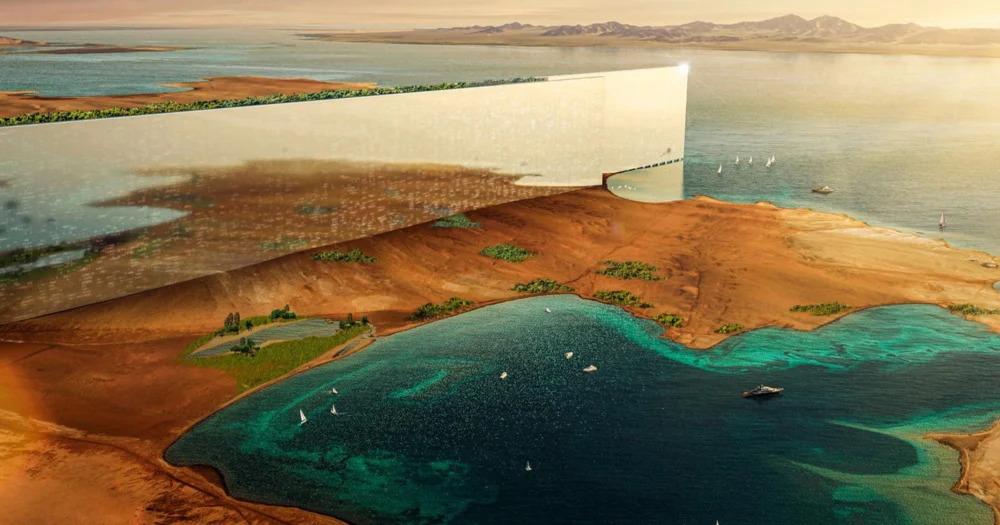
The audacious vision for Neom, Saudi Crown Prince Mohammed bin Salman’s (MBS) $1.5 trillion-with-a-t futuristic megacity, has been a subject of both awe and profound skepticism since its inception. Positioned as a beacon of innovation and sustainable living in the remote Tabuk province of Saudi Arabia, its centerpiece, a towering linear city dubbed "The Line," was designed to stretch an impossible 170 kilometers (over 100 miles) across the desert. This mirrored metropolis, 500 meters high and 200 meters wide, promised to house nine million residents within its reflective walls, offering a utopian existence free of cars, roads, and carbon emissions, powered entirely by artificial intelligence. From the outset, the sheer scale and revolutionary concepts of The Line challenged the very laws of reality, leading many to predict its inevitable downfall. Now, as the desert dust settles on these grand ambitions, reports suggest a dramatic and almost comical pivot, signaling a profound reality check for the kingdom’s futuristic dreams.
According to new reporting from the Financial Times, the Saudi government is reportedly considering a drastic downsizing of this monumental linear city-skyscraper. The initial phase of The Line, once envisioned to span 170 kilometers, is now projected to extend a mere 2.4 kilometers by 2030. This monumental scaling back isn’t merely a reduction in scope; it accompanies a wholesale reorientation of Neom’s core purpose. Instead of a thriving, car-free urban paradise, the kingdom is now reportedly planning to transform Neom into a colossal hub for — and this is where the desperation truly sets in — data centers.
This abrupt shift, from a human-centric utopian city to a sprawling server farm, reeks of a Saudi leadership scrambling to find a viable path out of the multibillion-dollar hole it has meticulously dug for itself. The move appears to be a reactive maneuver, a desperate rush to align with the prevailing global trend and cash in on the burgeoning artificial intelligence (AI) race. With the world clamoring for increased computing power to fuel AI advancements, the demand for data centers is skyrocketing. For Saudi Arabia, a nation still heavily reliant on oil revenues despite its diversification efforts, this presents a seemingly low-hanging fruit, a ready-made industry to pivot towards.
Royal insiders, however, attempt to spin this dramatic reversal as a testament to the Saudi government’s inherent flexibility and adaptability. “It shows that the system has a capacity to adjust its goals,” one anonymous source told the FT, attempting to frame the retreat from an impossible dream as a strategic re-evaluation. Yet, for many observers, this narrative struggles to mask the underlying reality: the original vision for The Line was fundamentally flawed, economically unsustainable, and logistically unachievable, forcing a humiliating climbdown.
The pivot comes as Riyadh concludes a year-long review of Neom’s progress, a period that has coincided with increasing financial pressures on the kingdom. This belt-tightening is evident across the government’s myriad, exorbitantly expensive investments, which extend far beyond Neom. Saudi Arabia’s Public Investment Fund (PIF), a sovereign wealth fund championed by MBS as the engine of Vision 2030 – the country’s ambitious plan to diversify its oil-dependent economy – has poured billions into everything from acquiring entire European football leagues and teams to investing heavily in competitive video games and other global ventures. Ostensibly aimed at building a post-oil economy, these investments are now becoming increasingly burdensome as global oil prices have experienced periods of steady decline, reportedly leaving the purportedly trillion-dollar PIF low on readily available cash. Neom, with its unprecedented budget and slow progress, has become a significant drain on these resources.
Jumping on the AI bandwagon, therefore, represents a potentially lucrative, albeit less glamorous, path forward for the Saudis. The logic, as explained by the FT’s source, is that Neom’s proximity to the Gulf of Aqaba makes it uniquely suited for hosting massive data centers. “Data centers need water cooling and this is right on the coast so it will have seawater cooling,” the source noted, adding, “So it will be a major center for data centers.” While seawater cooling is not the conventional method, typically involving immense energy consumption for chilled air systems, its proponents argue it could offer an environmentally friendlier alternative in the right conditions. However, the sheer scale of energy and water required for such an endeavor, even with seawater cooling, in a hyper-arid desert environment raises significant new environmental concerns. The very desert landscape that was meant to host a sustainable city now risks becoming an industrial zone for power-hungry servers, demanding vast infrastructure development for power generation and water treatment.
The extent to which The Line will be downscaled remains somewhat unclear, but it is evident that its original form is being abandoned. The FT’s source indicated that architects are already working on redesigning the megastructure into a more “modest” and radically changed project. “The Line will be a totally different concept. It will use the existing infrastructure in a totally different manner,” the person told the FT. This suggests that whatever remnants of The Line persist will bear little resemblance to the initial, breathtaking renderings.
The linear city has been embroiled in controversy since its very conception, extending far beyond its outrageous scale and exorbitant costs. The project has been marred by severe human rights abuses, including the forced displacement of the indigenous Howeitat tribe, who have inhabited the Neom region for generations. Reports have detailed instances of tribe members being forcibly evicted from their ancestral lands, with some facing imprisonment and even death sentences for resisting the displacement. Furthermore, the construction of Neom has reportedly taken a grim toll on construction workers, with thousands believed to have died while laboring on the project under harsh conditions, a grim reality often obscured by the shiny facade of futuristic promises. These ethical concerns have cast a long shadow over the entire Neom endeavor, making its potential pivot to data centers a further test of global ethical investment standards.
Neom has repeatedly denied previous reports suggesting that The Line could be downsized, maintaining a defiant stance against growing skepticism. However, the latest Financial Times report, citing multiple informed sources, indicates a significant shift in internal planning. As it stands, the ultimate fate of The Line and the broader Neom project hinges on the ongoing review, which is slated to conclude by or near the end of the first quarter of this year. The outcome will not only determine the future of a multi-trillion-dollar investment but also serve as a crucial barometer for Saudi Arabia’s ambitious Vision 2030 and its capacity to translate grandiose visions into tangible, sustainable realities.
The irony of replacing a dream of human habitation with a haven for machines is stark. It underscores the challenges of top-down urban planning, particularly when divorced from practical realities and human considerations. While data centers are undeniably crucial infrastructure for the digital age, their sudden adoption as the primary focus for Neom signals a retreat from an imaginative, albeit flawed, vision towards a more pragmatic, yet arguably less inspiring, industrial purpose. The world watches to see if Saudi Arabia can indeed build a "major center for data centers" in the desert, or if this latest iteration of Neom will also crumble under the weight of its own ambition and the relentless demands of the desert environment.
More on AI: AI Data Centers Pushing Electric Grid Into Meltdown