Faris Adani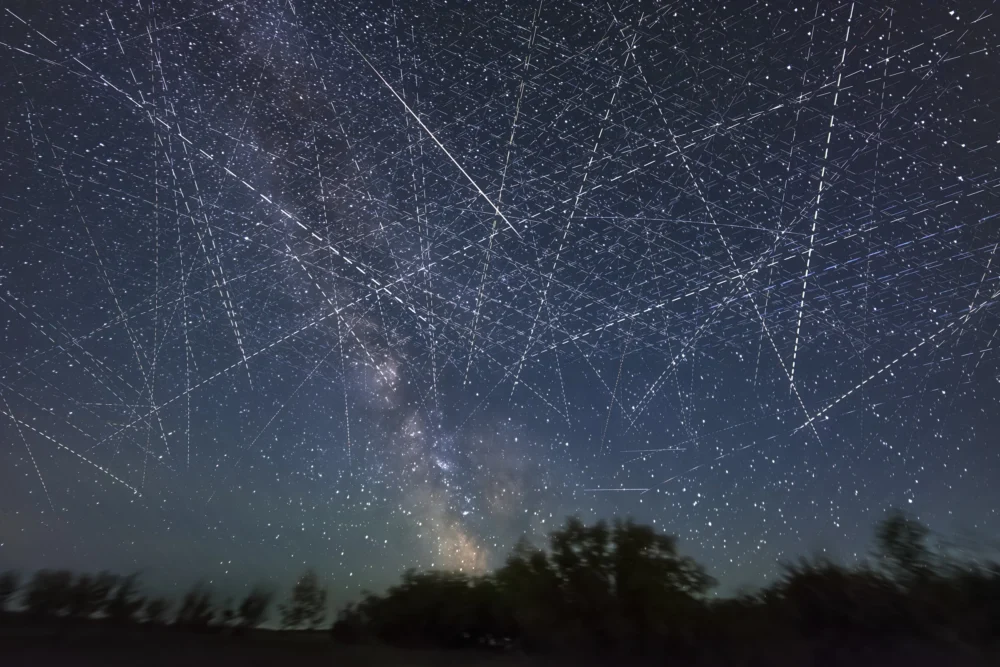
Humanity faces an escalating threat not just from climate change, but from the very space we increasingly rely on, as a recent study warns that Earth’s low Earth orbit (LEO) could rapidly descend into a destructive maelstrom of space debris. This alarming scenario, a grim twist on the long-theorized Kessler syndrome, suggests that a powerful solar storm could trigger a catastrophic chain reaction, trapping humanity on Earth and setting back space exploration for decades.
For decades, low Earth orbit, typically defined as altitudes below 2,000 kilometers (1,200 miles), has been a vital highway for scientific research, communication, navigation, and national security. It hosts the International Space Station, Earth observation satellites, weather forecasting systems, and the burgeoning networks of internet-beaming constellations. However, this critical region is becoming dangerously congested. Thousands of operational satellites, alongside hundreds of thousands of pieces of defunct spacecraft, spent rocket stages, and tiny fragments of debris, are hurtling around our planet at incredible speeds—up to 27,000 kilometers per hour (17,000 mph). Even a millimeter-sized paint fleck can cause significant damage at such velocities, let alone larger objects.
The core concern revolves around the Kessler syndrome, a theoretical scenario first proposed by NASA scientist Donald Kessler in 1978. It describes a runaway chain reaction where the density of objects in LEO becomes so high that collisions between objects generate enough new debris to increase the likelihood of further collisions. This escalating cycle, once initiated, could render certain orbital altitudes unusable for generations. Kessler originally envisioned this process unfolding gradually over many years, a slow-motion catastrophe. However, the unprecedented pace of launches and the sheer volume of objects now in orbit are dramatically accelerating this timeline, making the syndrome a far more immediate and pressing concern.
Driving this increased congestion are the "megaconstellations" of satellites, spearheaded by companies like Elon Musk’s SpaceX. With over 9,000 Starlink satellites already in orbit and plans for tens of thousands more, SpaceX alone accounts for the vast majority of active satellites. Amazon is rapidly following suit with its Project Kuiper, and China has announced ambitious plans for its own colossal networks, potentially adding nearly 200,000 satellites to LEO. While these constellations promise global internet access and other services, their sheer numbers significantly amplify the risk of collisions. SpaceX’s Starlink satellites, for instance, had to perform over 300,000 collision avoidance maneuvers in 2025 alone, a testament to the precarious ballet unfolding daily in LEO. Each maneuver consumes fuel and reduces the operational lifespan of a satellite, and each failed maneuver carries the risk of initiating a cascade.
The new, yet-to-be-peer-reviewed study introduces a chilling accelerant to the Kessler syndrome: a violent solar storm. These outbursts from the Sun, typically originating from solar flares or coronal mass ejections (CMEs), unleash torrents of charged particles and electromagnetic radiation that can wreak havoc on Earth’s magnetosphere and technological infrastructure. The most infamous historical example is the Carrington Event of 1859, which caused widespread disruptions to telegraph systems and sparked auroras visible worldwide. A similar event today would likely cause widespread power grid blackouts, disrupt global communications, and, critically, severely impair satellites.
The impact of a powerful solar storm on satellites would be multi-faceted. The electromagnetic pulses could fry sensitive electronics, leading to system failures and loss of control. Increased atmospheric drag caused by the heating and expansion of Earth’s upper atmosphere could alter satellite orbits unpredictably. Most critically, it could disrupt GPS and navigation systems, effectively blinding satellites and severing communication links with ground control. Without the ability to track their precise positions or receive commands for collision avoidance, the thousands of satellites currently performing intricate dance moves to prevent crashes would suddenly become unresponsive, uncontrollable projectiles.
To quantify this immediate danger, the researchers developed a new metric: the CRASH clock. This innovative tool measures the time it would take for a catastrophic collision to occur if satellites were to lose their navigation capabilities during a crisis like a solar storm. Their calculations reveal a startling proximity: satellites in low Earth orbit are projected to have a "close approach"—passing within one kilometer of each other—approximately every 36 seconds. Factoring in this terrifying frequency and the loss of autonomous collision avoidance, the CRASH clock ticks down to a mere 5.5 days. This means humanity would have less than a week to intervene before an uncontrollable cascade of collisions could begin, transforming LEO into a chaotic, impassable debris field.
The implications of such an orbital collapse extend far beyond the realm of space exploration. Our modern world is inextricably linked to satellites. GPS systems underpin global transportation, logistics, and countless apps. Weather satellites provide crucial data for forecasting and climate monitoring. Communication satellites facilitate global connectivity, internet services, and emergency responses. National security relies heavily on intelligence, surveillance, and reconnaissance (ISR) satellites. A rapid, widespread loss of these assets would trigger an unprecedented global crisis, disrupting economies, paralyzing essential services, and potentially destabilizing international relations. The financial cost would be in the trillions, but the human cost in terms of disrupted aid, communication failures, and loss of life from unforeseen events could be immeasurable.
While the immediate threat of a Carrington-level event would undoubtedly present more pressing terrestrial concerns, the long-term consequences of losing LEO would be equally catastrophic. It would effectively trap humanity on Earth, cutting off access to a vital domain for scientific progress, technological innovation, and our collective future. Recovering from such a scenario would be a monumental task, requiring decades, if not centuries, to clear the debris and safely re-establish orbital operations.
Averting this looming disaster requires a multi-pronged approach rooted in international cooperation and responsible space stewardship. Firstly, stricter regulations for satellite launches and operations are essential. This includes mandating that all new satellites be equipped with reliable de-orbiting capabilities (such as drag sails or propulsion systems) to ensure they safely re-enter the atmosphere at the end of their operational lives. Secondly, active debris removal technologies, which are currently in experimental stages, need to be rapidly developed and deployed. Concepts range from robotic arms and nets to capture larger defunct satellites, to laser systems that could nudge smaller debris into lower orbits where they would burn up. Thirdly, improved space situational awareness (SSA) and traffic management systems are crucial to track every object in orbit and predict potential collisions with greater accuracy, allowing for more effective avoidance maneuvers.
The threat of a rapidly collapsing low Earth orbit serves as a stark reminder of the delicate balance we maintain with our technological advancements. Just as we grapple with the consequences of climate change on our planet, we must also confront the environmental impact of our activities in space. The scientific community has sounded the alarm; now it is up to governments, space agencies, and private companies to collaborate on a sustainable future for LEO, ensuring that this vital frontier remains accessible for generations to come. The alternative is an orbital junkyard, a testament to humanity’s ambition, but also to its oversight.