Imroatul Nasiyah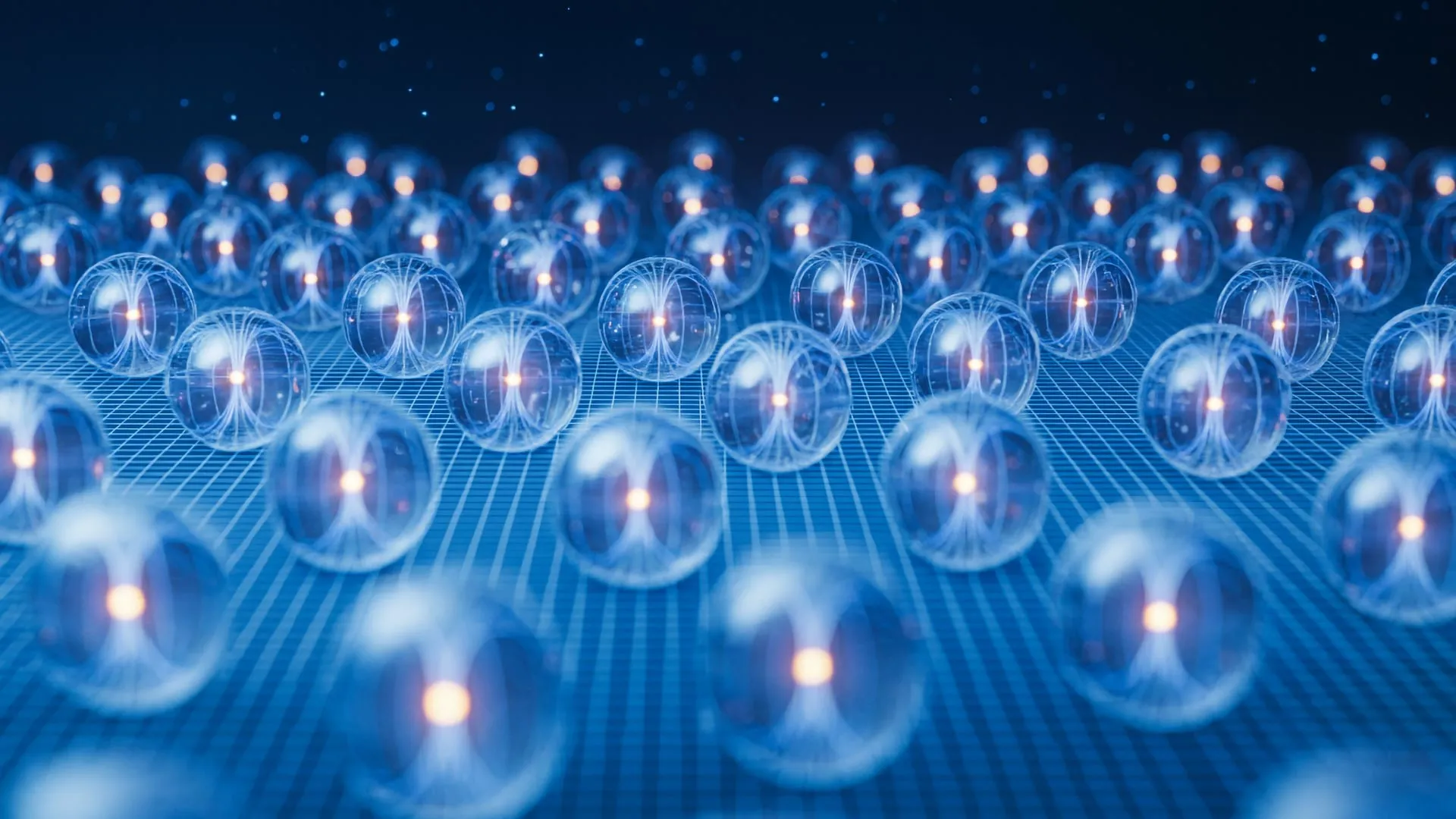
The quest for powerful quantum computers, capable of revolutionizing fields like physics, chemistry, and medicine, hinges on the ability to harness the unique properties of qubits. Unlike their classical counterparts, which exist as either a 0 or a 1, qubits can simultaneously represent both states through a phenomenon known as superposition. This inherent quantum quirk bestows upon quantum computers the potential to outperform classical machines in tackling specific, complex computational challenges. However, this power comes with a significant caveat: qubits are exceptionally fragile, prone to errors from even the slightest environmental disturbance. To overcome this inherent vulnerability, researchers are developing strategies that involve incorporating a substantial number of redundant qubits, a concept known as quantum error correction. The ultimate goal is to build robust quantum computers that can reliably perform calculations, a vision that necessitates the development of systems boasting hundreds of thousands, if not millions, of these delicate quantum bits.
In a pivotal stride towards this ambitious future, physicists at the California Institute of Technology (Caltech) have unveiled an unprecedented achievement: the creation of the largest neutral-atom qubit array ever assembled, comprising a staggering 6,100 qubits meticulously arranged and trapped in a precise grid by lasers. This groundbreaking development shatters previous records, as prior arrays of this nature typically housed only a few hundred qubits. The Caltech team’s success arrives at a critical juncture, amidst an increasingly intense global race to scale up quantum computing capabilities. This competition spans a diverse array of technological approaches, including those leveraging superconducting circuits, trapped ions, and the neutral-atom platform that formed the basis of the new study.
"This is an incredibly exciting moment for neutral-atom quantum computing," exclaimed Manuel Endres, a distinguished professor of physics at Caltech and the principal investigator of the research. "We can now clearly discern a viable pathway towards the realization of large-scale, error-corrected quantum computers. The fundamental building blocks are demonstrably in place." The groundbreaking findings of this research were formally published on September 24th in the esteemed scientific journal Nature. The study itself was spearheaded by three dedicated Caltech graduate students: Hannah Manetsch, Gyohei Nomura, and Elie Bataille, whose collective efforts were instrumental in achieving this significant milestone.
The ingenious methodology employed by the Caltech team involved the use of optical tweezers – highly focused laser beams – to precisely trap thousands of individual cesium atoms within a carefully constructed grid. To construct this expansive atomic array, the researchers ingeniously split a single laser beam into an astonishing 12,000 individual tweezers. These numerous tweezers worked in concert to suspend and hold precisely 6,100 cesium atoms within the controlled environment of a vacuum chamber. "On the monitoring screen, we can actually observe each individual qubit as a distinct pinpoint of light," shared Manetsch, offering a vivid glimpse into the tangible reality of this advanced quantum hardware. "It’s a truly striking visual representation of quantum technology operating at such a monumental scale."
A particularly crucial aspect of this achievement was the team’s successful demonstration that this significant increase in scale did not come at the expense of qubit quality – a common concern in scaling up quantum systems. Even with over 6,000 qubits coexisting within a single array, the researchers managed to maintain them in a coherent state of superposition for an impressive duration of approximately 13 seconds. This duration represents a nearly tenfold improvement over what was previously achievable with similar, smaller-scale arrays. Furthermore, the team exhibited an extraordinary level of control, demonstrating the ability to manipulate individual qubits with an accuracy of 99.98 percent. "The prevailing notion has been that achieving a large scale, with a greater number of atoms, inevitably leads to a compromise in accuracy. However, our results definitively show that we can achieve both simultaneously," stated Nomura, highlighting the dual success of quantity and quality. "Qubits, regardless of their number, are ultimately useless without a high degree of quality. We have now successfully demonstrated that we possess both in abundance."
Adding another layer of sophistication to their accomplishment, the team also proved their capability to precisely move individual atoms across the array over distances of hundreds of micrometers, all while preserving their delicate quantum superposition. This ability to dynamically shuttle qubits is a hallmark feature of neutral-atom quantum computers, offering a significant advantage in enabling more efficient and flexible error correction mechanisms compared to more traditional, physically wired platforms like superconducting qubits.
Manetsch eloquently likened the intricate task of moving individual atoms while simultaneously preserving their quantum superposition to the precarious act of balancing a glass of water while running. "The challenge of holding an atom while it’s in motion is akin to trying to keep a glass of water from tipping over. Then, attempting to maintain that atom in a state of superposition adds another layer of difficulty, much like trying to run at a pace that doesn’t cause the water to slosh out of the glass," she explained, illustrating the profound delicacy involved.
The next paramount challenge for the broader field of quantum computing is the successful implementation of quantum error correction techniques at the scale of thousands of physical qubits. The Caltech team’s work provides compelling evidence that neutral atoms are a remarkably strong contender to meet this critical requirement. "Quantum computers will fundamentally need to encode information in a manner that is inherently tolerant to errors, allowing us to perform meaningful and reliable calculations," emphasized Bataille. "A key distinction from classical computers is that qubits cannot be simply copied due to the fundamental principle known as the no-cloning theorem. Therefore, error correction strategies must rely on far more nuanced and sophisticated approaches."
Looking toward the horizon, the Caltech researchers are actively planning the next phase of their research: linking the qubits within their extensive array into a state of quantum entanglement. Entanglement is a phenomenon where individual quantum particles become inextricably correlated, behaving as a single, unified entity regardless of their physical separation. This state of interconnectedness is an indispensable prerequisite for quantum computers to transcend the mere storage of information in superposition and to begin executing complex, full-fledged quantum computations. It is precisely this entanglement that imbues quantum computers with their ultimate power – the profound ability to simulate the intricate workings of nature itself, where entanglement is the fundamental force shaping the behavior of matter across all scales. The overarching ambition is clear: to harness the power of entanglement to unlock unprecedented scientific discoveries, ranging from the unveiling of novel phases of matter to guiding the rational design of advanced materials and meticulously modeling the fundamental quantum fields that govern the very fabric of space-time.
"It is truly exhilarating to be at the forefront of creating machines that will empower us to explore and understand the universe in ways that are only possible through the lens of quantum mechanics," concluded Manetsch, reflecting the profound sense of purpose driving their research.
The groundbreaking study, titled "A tweezer array with 6100 highly coherent atomic qubits," received vital financial support from a consortium of esteemed organizations. These include the Gordon and Betty Moore Foundation, the Weston Havens Foundation, the National Science Foundation through its Graduate Research Fellowship Program, the Institute for Quantum Information and Matter (IQIM) at Caltech, the Army Research Office, the U.S. Department of Energy (including its Quantum Systems Accelerator initiative), the Defense Advanced Research Projects Agency (DARPA), the Air Force Office for Scientific Research, the Heising-Simons Foundation, and the AWS Quantum Postdoctoral Fellowship. Contributing significantly to the research authorship, alongside the lead graduate students, were Caltech’s Kon H. Leung, an AWS Quantum senior postdoctoral scholar research associate in physics, and former Caltech postdoctoral scholar Xudong Lv, who is now affiliated with the Chinese Academy of Sciences.