Faris Adani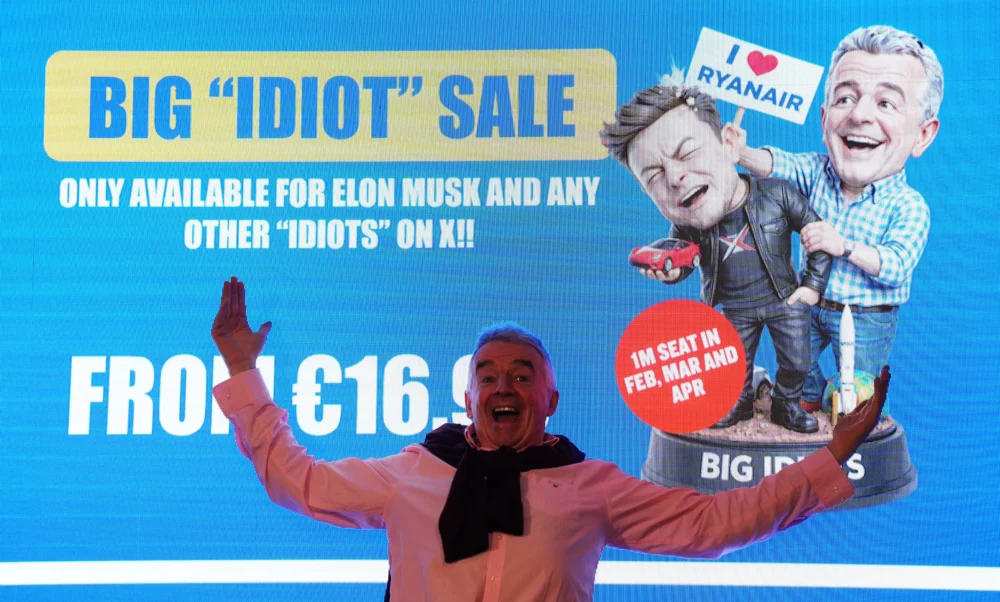
In an extraordinary display of turning a billionaire’s public tantrum into a marketing triumph, Michael O’Leary, the famously outspoken CEO of budget airline Ryanair, has publicly thanked Elon Musk for inadvertently driving a surge in bookings through their ongoing, highly personal feud. "We love these PR spats that drive bookings on Ryanair," O’Leary declared at a press conference in Dublin on Wednesday, as quoted by CNN, adding, "And we want to thank him sincerely for the additional publicity." This unusual commendation underscores a fascinating dynamic where Musk’s often-combative online persona, typically employed to champion his ventures or dismantle critics, has backfired spectacularly, instead becoming a free advertising campaign for one of Europe’s largest and most polarizing airlines.
The genesis of this peculiar war of words began last week when Ryanair, known for its no-frills approach and aggressively low fares, made a decisive announcement: it would not be equipping its vast fleet with Starlink technology, the satellite-based internet service spearheaded by Musk’s aerospace company, SpaceX. O’Leary, never one to mince words, provided a very specific and pragmatic rationale for the rejection. He claimed that the external antennas required for Starlink connectivity would introduce significant aerodynamic drag on the aircraft, leading directly to an increase in fuel consumption and, consequently, operational costs. For an airline built on razor-thin margins and meticulous cost control, even a marginal increase in fuel expenditure is a major consideration.
Musk, whose public reactions often betray a thin skin, could barely conceal his annoyance at the snub. His initial response on X (formerly Twitter) was to label O’Leary as "misinformed." He went further, casting doubt on Ryanair’s operational precision by stating he "doubted Ryanair can even measure the difference in fuel use accurately." This seemingly dismissive retort, however, only served as an open invitation for O’Leary, a seasoned provocateur, to escalate the conflict.
Sensing an opportunity for precisely the kind of free publicity Ryanair has masterfully leveraged for decades, O’Leary wasted no time in fanning the flames. He promptly granted an interview to the Irish radio station Newstalk, where he launched a blistering, no-holds-barred attack on the world’s richest man. "I would pay no attention whatsoever to Elon Musk," O’Leary scoffed, delivering the now-iconic line: "He’s an idiot. Very wealthy, but he’s still an idiot. What Elon Musk knows about flights and drag would be zero." This direct, unvarnished insult, delivered with O’Leary’s characteristic blend of bluster and theatricality, was a masterstroke designed to elicit a strong reaction.
Musk, predictably, swallowed the bait whole. His composure, already frayed, snapped. O’Leary was no longer merely "misinformed"; he had been upgraded to a "retarded twat who needs to be fired," a deeply offensive and unprofessional outburst from the CEO of multiple major corporations. This inflammatory comment was posted in response to Ryanair’s official X account, which, clearly enjoying the drama, had playfully joked that WiFi on planes was a "scam." The escalation in Musk’s language highlighted not only his frustration but also his apparent inability to resist engaging in petty personal attacks, a pattern that has become increasingly visible since his acquisition of X.
The feud took an even more bizarre turn when Musk, seemingly losing touch with reality, threatened to buy out the entire airline. He then posted a poll on X, asking his millions of followers whether he should "restore Ryan as their rightful ruler" once he completed the acquisition. This particular move exposed a glaring lack of basic knowledge on Musk’s part. The "Ryan" he presumably referred to was the late Irish billionaire Tony Ryan, who co-founded Ryanair but passed away in 2007. The gaffe underscored the impulsive nature of Musk’s online pronouncements, suggesting a lack of research or consultation even with his own AI, Grok, before engaging in such public declarations. Tony Ryan, a visionary in aviation, had laid the groundwork for Ryanair’s low-cost model, but his direct involvement ceased long before Musk’s social media antics.
O’Leary and the Ryanair social media team, however, were not to be outdone. They seized on Musk’s increasingly unhinged responses with glee. Tagging Musk’s account directly, the official Ryanair account triumphantly announced the launch of a "Great Idiots seat sale" dedicated explicitly to "Elon and any other idiots on ‘X’." They further declared that O’Leary would be holding a press conference "to address (undress??)" Musk’s "latest Twitshit." The deliberate, playful misspelling and the suggestive "undress" added another layer of provocative humor, demonstrating Ryanair’s comfort in pushing boundaries, a strategy that has defined their marketing for decades.
And again, Musk fell for the trap. His subsequent response was arguably his most egregious yet: "The insufferable, special needs chimp currently running Ryan Air is an accountant," he fumed, adding, "Has no idea how airplanes even fly." This deplorable comment, laced with ableist language and personal slurs, drew widespread condemnation and further cemented O’Leary’s position as the clear winner in the court of public opinion. It also highlighted a disturbing trend in Musk’s online behavior, where perceived slights often lead to highly inappropriate and offensive retaliations.
Ryanair and its CEO, Michael O’Leary, are by no means strangers to controversy; in fact, they actively court it. Their marketing history is replete with audacious, often scandalous campaigns designed to grab headlines and provoke reactions. Yet, in this particular spat, Musk was thoroughly outdone at his own game. At the Wednesday press conference, O’Leary gloated about the resounding success of the "Big Idiot Seat Sale," confirming that the publicity had indeed translated into tangible bookings. He remained entirely unfazed by Musk’s tirades, adopting a world-weary, almost parental tone. "As anybody with teenage children would know, you’re frequently called an idiot and a twat at home," he quipped, per CNN. "I don’t need to go outside to be insulted." This masterful deflection reframed Musk’s insults as childish and inconsequential, further diminishing their impact.
O’Leary also took the opportunity to deliver a parting shot regarding Musk’s fanciful threat to buy the airline. He clarified that, due to European regulations, only European citizens could own European airlines, thereby neatly shutting down Musk’s acquisition fantasy. However, he extended an open invitation for Musk to pour money into the company, albeit as a non-controlling investor. "We would think it’s a very good investment, certainly a significantly better investment than the financial returns he is earning on X," O’Leary smirked, landing a final, pointed jab at the struggling financial performance of Musk’s social media platform.
This entire episode serves as a fascinating case study in brand management, public relations, and the unpredictable nature of online celebrity feuds. Elon Musk, for all his entrepreneurial brilliance and visionary projects, has consistently demonstrated a lack of emotional intelligence in his public interactions, often resorting to personal attacks and inflammatory language. His brand, once synonymous with innovation and the future, is increasingly being tarnished by these unforced errors.
Conversely, Michael O’Leary and Ryanair have once again showcased their uncanny ability to transform negative attention into commercial gain. Their marketing playbook has always been about irreverence, directness, and an almost gleeful disregard for conventional corporate niceties. By positioning themselves as the underdog against the world’s richest man, and by cleverly using Musk’s own insults against him, they’ve not only generated immense free publicity but also reinforced their brand image as a cheeky, no-nonsense airline that thrives on disruption.
The broader context of Starlink in aviation is also worth noting. While Starlink promises high-speed, low-latency internet, it’s not the only player in the in-flight connectivity market. Competitors like Viasat, Intelsat, and OneWeb offer various solutions, each with its own trade-offs regarding cost, speed, coverage, and installation complexity. For a budget airline like Ryanair, every decision is scrutinized through a cost-benefit lens. O’Leary’s argument about drag and fuel costs, while perhaps exaggerated for dramatic effect, highlights a genuine concern for carriers operating on slim margins. The choice of in-flight WiFi provider is a complex one, involving technical integration, long-term costs, passenger experience, and regulatory hurdles, far beyond the scope of a simple "yes" or "no" to Musk’s technology.
Ultimately, this feud illuminates the stark contrast between two highly public figures. Musk, with his impulsive and often aggressive social media habits, appears to be his own worst enemy in these situations. O’Leary, on the other hand, a master of calculated provocation, understands that for certain brands, any publicity—even negative—can be gold, especially when delivered by a figure as prominent as Elon Musk. In this particular battle of wits and public image, it is undeniably O’Leary and Ryanair who have emerged victorious, turning Musk’s unlikability into a surprising, and highly profitable, marketing asset.
More on Elon Musk: Elon Musk Says His Optimus Robot Is So Dope That People Will Forget Tesla Ever Made Cars