Faris Adani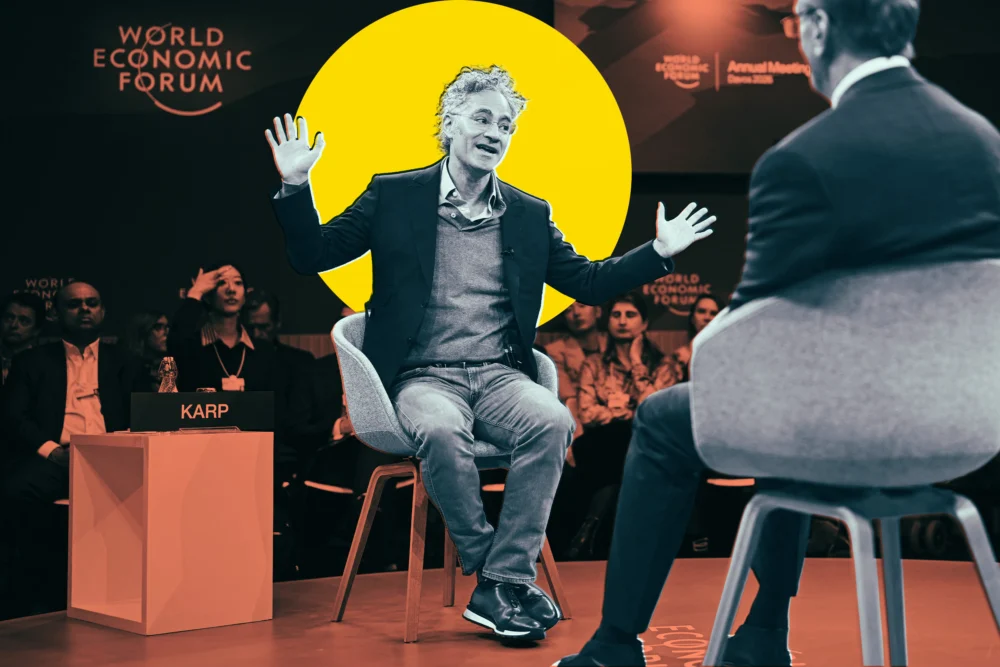
Palantir CEO Alex Karp ignited a firestorm of debate at the World Economic Forum in Davos, Switzerland, with a stark and controversial prediction about the future of work in an AI-dominated world, asserting that the vast majority of humanity will be relegated to vocational and manufacturing roles, essentially performing manual "grunt work" with their hands, while intellectual and humanities-focused professions face imminent destruction at the hands of artificial intelligence, a pronouncement delivered by a man who himself holds advanced degrees in philosophy and law from elite institutions and commands a multi-billion-dollar fortune, thereby setting himself apart from the very future he envisions for the global workforce. Speaking to a gathering of the world’s economic and political elite, Karp painted a picture where traditional white-collar aspirations, particularly those rooted in liberal arts education, are a recipe for "certain doom," explicitly warning, "You went to an elite school, and you studied philosophy; hopefully you have some other skill," before adding that AI "will destroy humanities jobs." This striking declaration, coming from the head of a data analytics firm deeply embedded in government and corporate surveillance, immediately drew accusations of hypocrisy and a perceived disconnect from the realities faced by ordinary citizens, given Karp’s own educational background from Haverford College and Stanford Law, which equipped him with the very "humanities degrees" he now dismisses as obsolete. His personal net worth, estimated at $15.5 billion, places him firmly within the global financial elite, granting him a lifestyle that has been likened to that of a "feudal lord" – a stark contrast to the assembly line future he prescribes for the masses.
Karp’s vision for the future workforce is one centered on tangible, physical labor. He championed roles like "vocational technician" or those involved in "building batteries for a battery company," describing them as "very valuable, if not irreplaceable." This perspective aligns with a broader narrative from some tech leaders who believe that while AI will automate cognitive tasks, it will simultaneously create demand for roles requiring physical dexterity, specialized technical skills, and hands-on problem-solving that remain challenging for current robotics and AI systems to fully replicate. However, critics quickly pointed out the inherent contradiction in a tech titan, whose company profits from sophisticated data algorithms and advanced software, advocating for a future where intellectual labor is devalued for everyone but those at the very top. Palantir Technologies, co-founded by Karp and Peter Thiel, specializes in big data analytics, offering powerful tools to governments, intelligence agencies, and corporations for everything from counter-terrorism to supply chain management. The nature of Palantir’s business—analyzing vast datasets to identify patterns, predict behaviors, and support complex decision-making—itself relies heavily on advanced cognitive processes, algorithms, and the human intellect required to design, interpret, and apply these systems. Therefore, Karp’s dismissal of intellectual pursuits for the general populace, while his own enterprise thrives on high-level cognitive work, raises questions about the kind of societal hierarchy he implicitly endorses.
The broader conversation around AI’s impact on employment is far more nuanced than Karp’s binary "intellectual doom, manual salvation" scenario. While automation has historically displaced certain jobs, it has also created entirely new industries and roles. Economists and futurists offer diverse predictions: some foresee widespread job losses across sectors, including manufacturing as advanced robotics become more capable; others anticipate a shift towards jobs requiring uniquely human skills like creativity, emotional intelligence, critical thinking, and complex problem-solving—precisely the attributes often cultivated by a humanities education. Moreover, the "irreplaceability" of vocational jobs is itself a moving target. Advances in robotics, augmented reality, and AI-powered tools are continually enhancing capabilities in manufacturing, construction, and other skilled trades, potentially automating aspects of these roles that currently require human intervention. For instance, sophisticated robots can now perform assembly tasks with increasing precision, and AI is being integrated into design, quality control, and predictive maintenance in factories. Thus, even the "vocational technician" of today may find their role evolving dramatically or facing new forms of automation in the coming decades.
Karp’s comments also carry a distinct socio-economic and political undertone. His casual reference to "my usual political screeds" and the assertion that "there will be more than enough jobs for the citizens of your nation, especially those with vocational training," hint at a nationalist or protectionist perspective, potentially linking job security to citizenship and specific skill sets, possibly implying a stance against immigration or globalized labor markets. This framing suggests a particular vision for national economies, prioritizing a domestic, hands-on workforce over a more globally integrated, intellectually diverse one. The ethical implications of a future where a small elite controls the advanced AI and intellectual capital, while the majority is directed towards manual labor, are profound. It risks exacerbating existing inequalities, creating a rigid class structure where access to higher-level, fulfilling work is determined not by merit or passion, but by a technologically enforced societal division. This "worker bee" mentality, as critics have termed it, reduces the majority of humanity to cogs in a machine designed and operated by a select few, raising concerns about human dignity, purpose, and the very definition of progress.
Furthermore, the value of a humanities education in an AI era is a topic of robust debate among educators and industry leaders alike. While AI excels at processing data and performing repetitive tasks, it often struggles with abstract reasoning, ethical considerations, nuanced communication, and understanding the human condition – areas where humanities graduates typically excel. Many argue that critical thinking, adaptability, empathy, and creativity, fostered through disciplines like philosophy, literature, and history, will be more crucial than ever in navigating a rapidly changing world, collaborating with AI, and addressing the complex societal challenges that arise from technological advancement. These skills are essential not just for innovating new technologies but also for governing their use, ensuring ethical deployment, and shaping a future that benefits all of humanity, not just a privileged few. Proposals like Universal Basic Income (UBI) or massive investment in lifelong learning and retraining programs are often discussed as potential solutions to mitigate job displacement and ensure a dignified existence for all, regardless of their direct contribution to a tech-driven economy. Karp’s narrow prescription, however, seems to bypass these broader societal considerations, focusing instead on a specific type of labor as the only viable path for the non-elite.
In conclusion, Alex Karp’s provocative statements at the World Economic Forum serve as a powerful, albeit controversial, articulation of one possible future shaped by AI. His vision of a world where most people engage in manual, vocational work while intellectual labor is automated out of existence for the majority, coming from a tech billionaire with an elite humanities background, underscores a growing chasm between those who stand to profit immensely from the AI revolution and those who might find their professional lives fundamentally redefined. It raises critical questions about equity, the purpose of education, and the kind of society we are collectively building. While there is undeniable value in vocational skills and manufacturing, reducing the future of humanity’s labor to primarily physical tasks, while an elite controls the intellectual and technological levers, presents a stark, almost dystopian, challenge to notions of progress and shared prosperity, inviting us to critically examine whose future is being shaped, and by whom.