Faris Adani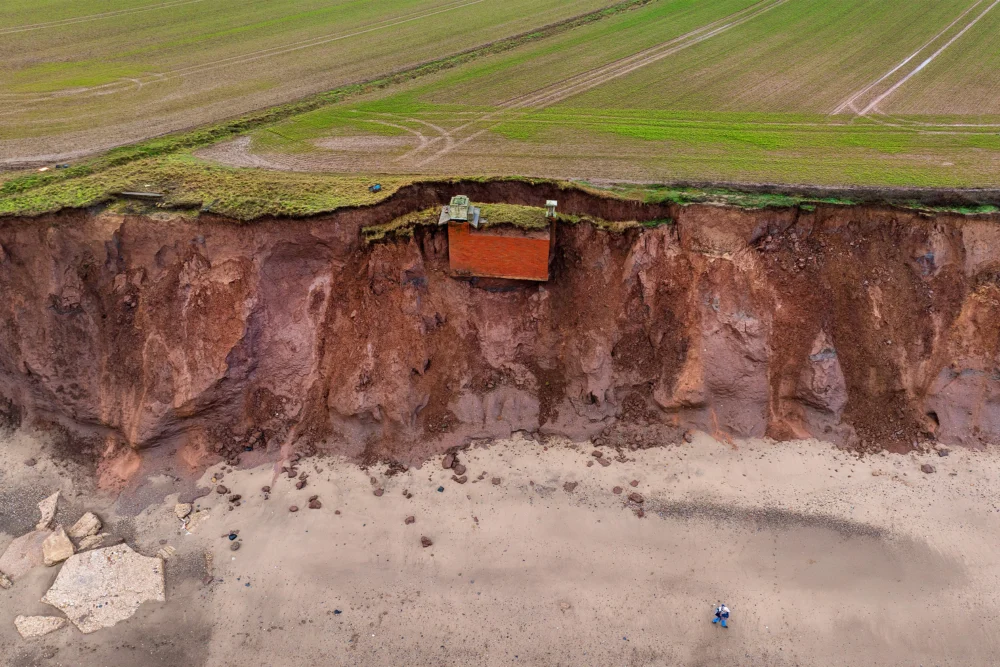
Perched precariously on the precipice of a rapidly crumbling cliff face, a former nuclear bunker near Tunstall on the East Yorkshire coast stands as a stark and unnerving symbol of contemporary global anxieties. This Cold War relic, designed to withstand the unimaginable horrors of nuclear fallout, is now just days away from succumbing to the relentless assault of the sea, a powerful testament to the accelerating forces of coastal erosion, exacerbated by a warming planet. The striking image of this concrete sentinel, once a bulwark against one existential threat, now teetering on the edge of another, encapsulates a profound societal unease, hinting at an "imminent catastrophe" that feels increasingly palpable.
The brick structure, officially known as the Tunstall Royal Observer Corps Post, was erected in 1959 at the height of the Cold War. It was one of approximately 1,560 such underground monitoring posts built across the United Kingdom, part of a nationwide network operated by the Royal Observer Corps (ROC). The ROC, a civilian volunteer organization, played a critical role in the UK’s nuclear deterrent strategy, tasked with detecting, identifying, and reporting nuclear explosions, as well as monitoring radioactive fallout in the event of a nuclear attack. These posts were designed to be self-sufficient, allowing a small crew of three or four observers to live underground for several weeks, sealed off from the contaminated surface world. Their primary mission was to gather vital data on blast locations, yields, and fallout patterns, which would then be transmitted to regional and national command centers to aid in post-attack planning and survival efforts.
Life inside these bunkers was austere and challenging. Typically comprising a cramped monitoring room and a chemical toilet, with rudimentary sleeping arrangements, the posts were equipped with specialized instruments like the Bomb Power Indicator (BPI), Ground Zero Indicator (GZI), and Fixed Survey Meter (FSM) for detecting and measuring nuclear events. For those stationed within, it was a lonely vigil, a constant readiness for a cataclysmic event that, thankfully, never materialized. The Tunstall post, like many others, was strategically located to offer optimal observation of the surrounding area, its sturdy construction intended to provide protection against blast effects and radiation. With the thawing of the Cold War and the strategic review of nuclear defense capabilities, the Royal Observer Corps was finally stood down in 1991, leaving behind a legacy of these unique subterranean structures, many of which have since been abandoned, sold off, or repurposed.
Today, however, the fate of the Tunstall bunker is far less secure. The East Yorkshire coastline, particularly the Holderness Coast, is renowned as one of Europe’s most rapidly eroding coastlines. The cliffs, composed primarily of soft glacial tills – a mix of clay, sand, and gravel – are highly susceptible to the erosive power of the North Sea. Natural processes such as hydraulic action, abrasion, and attrition, combined with freeze-thaw weathering and mass movement (landslides and slumping), have historically shaped this dynamic coastline. However, in recent decades, the rate of erosion has demonstrably accelerated, a phenomenon widely attributed to the pervasive effects of global climate change. Rising sea levels mean that the base of the cliffs is exposed to wave action for longer periods, while more frequent and intense storm events batter the coast with greater force. The loss of protective beaches, sometimes due to changes in sediment supply or coastal defenses further along the coast, also contributes to the vulnerability of the cliffs.
For communities like Tunstall, the impact of this relentless erosion is profoundly felt. Homes, farms, roads, and historical landmarks have been progressively swallowed by the sea. The average erosion rate along parts of the Holderness Coast can exceed two meters per year, making it an ever-present threat to human habitation and infrastructure. The sight of the Tunstall Royal Observer Corps Post, a structure built with permanence in mind, now hanging precariously over a void, serves as a chilling illustration of nature’s formidable power and the fragility of human endeavors in the face of such forces. The East Riding of Yorkshire Council has issued urgent warnings, advising locals and curious onlookers to steer clear of the area, both atop the crumbling cliff and below the bunker, citing the imminent danger of a collapse.
Among those meticulously documenting the bunker’s final days is Davey Robinson, an amateur historian. He and his partner have visited the Tunstall site every morning for the past nine days, capturing footage of its deteriorating state for their YouTube channel. "We live on one of the most eroded coastlines in Europe and this bunker hasn’t got long left, perhaps just a few days," Robinson told the BBC, his voice carrying a mix of fascination and somber recognition. His dedication reflects a broader public interest in observing the slow, inevitable surrender of a human-made structure to natural processes, a visual narrative that resonates globally. "We are posting the footage on our YouTube channel and it’s getting interest from around the world," Robinson noted, underscoring the universal appeal of this poignant spectacle. He eloquently summarizes the bunker’s current significance: "it’s a symbol of erosion in this area."
Beyond its immediate, localized drama, the impending fall of the Tunstall nuclear bunker into the sea carries profound symbolic weight, weaving together threads of past fears with present anxieties. It’s an ironic twist of fate that a structure designed as a refuge from a man-made apocalypse – nuclear war – is now succumbing to another, more insidious man-made crisis: climate change. The Cold War represented a tangible, immediate threat of mutually assured destruction, a dread that permeated global consciousness. Today, while the specter of nuclear conflict has not entirely vanished, it has been joined, and arguably overshadowed, by the slower, yet equally catastrophic, march of environmental degradation. The bunker’s demise thus becomes a powerful metaphor for humanity’s shifting existential threats.
This decaying monument highlights the illusion of control that humankind often projects over its environment. We build formidable structures, create intricate defense systems, and plan for worst-case scenarios, only to find that nature, when pushed beyond its limits, asserts its dominance in unexpected ways. The "doomsday glacier" in Antarctica, mentioned in the original report, whose "catastrophic collapse" is approaching, serves as another macro-level illustration of this same principle – a massive natural system responding to human-induced changes with potentially devastating global consequences. The world’s largest iceberg, A23a, which recently broke free from its decades-long grounding and began disintegrating, further underscores the dynamic and often unpredictable nature of our planet’s response to warming temperatures. These phenomena collectively paint a picture of a world teetering, much like the bunker itself, on the edge of a fundamental transformation, driven by forces we have unleashed.
The Tunstall bunker’s final moments are a somber reminder of the transient nature of human constructs against the backdrop of geological time and planetary processes. It serves as a visual elegy, mourning not just a physical structure, but perhaps a certain era of anxiety, giving way to a new, equally pressing set of concerns. As Davey Robinson aptly observed, "This whole area is eroding at a rapid rate and to see an actual physical thing moving it just shows what’s happening really." The nuclear bunker falling into the sea is more than just a local news story; it is a global parable, a stark illustration of how the legacies of past fears are being reshaped and recontextualized by the urgent realities of our changing climate. It stands as a silent, crumbling testament to the interconnectedness of human history, technological advancement, and the enduring power of the natural world.